

Which Canadian Investment Account Should You Open First?
A simple guide to TFSA, FHSA, RRSP, RESP, RDSP, and non-registered accounts using 2026 rules.
- Published
- 2026-09-28
- Last verified
- 2026-09-27
- Recheck by
- 2026-12-26
- Reading time
- 8 min read
- Revision
- rev.1
- Editorial approval
- Approved 2026-09-28
Co-authored and managed by John Park and his team of AI agents, orchestrated by AXE.
Which Canadian Investment Account Should You Open First?
The best account is the one that matches the job of the money. A TFSA, FHSA, RRSP, RESP, RDSP, and non-registered account solve different problems.
 A restrained sumi-e serpent-dragon walks beside a reader where garden paths lead toward a first home, an open gate, a retirement grove, a school pavilion, an accessible protected garden, and an open field.
Different accounts lead toward different goals. The Yimuki serpent is a guide through the choices, not a promise that one path is best. Conceptual art only.
The 2026 comparison
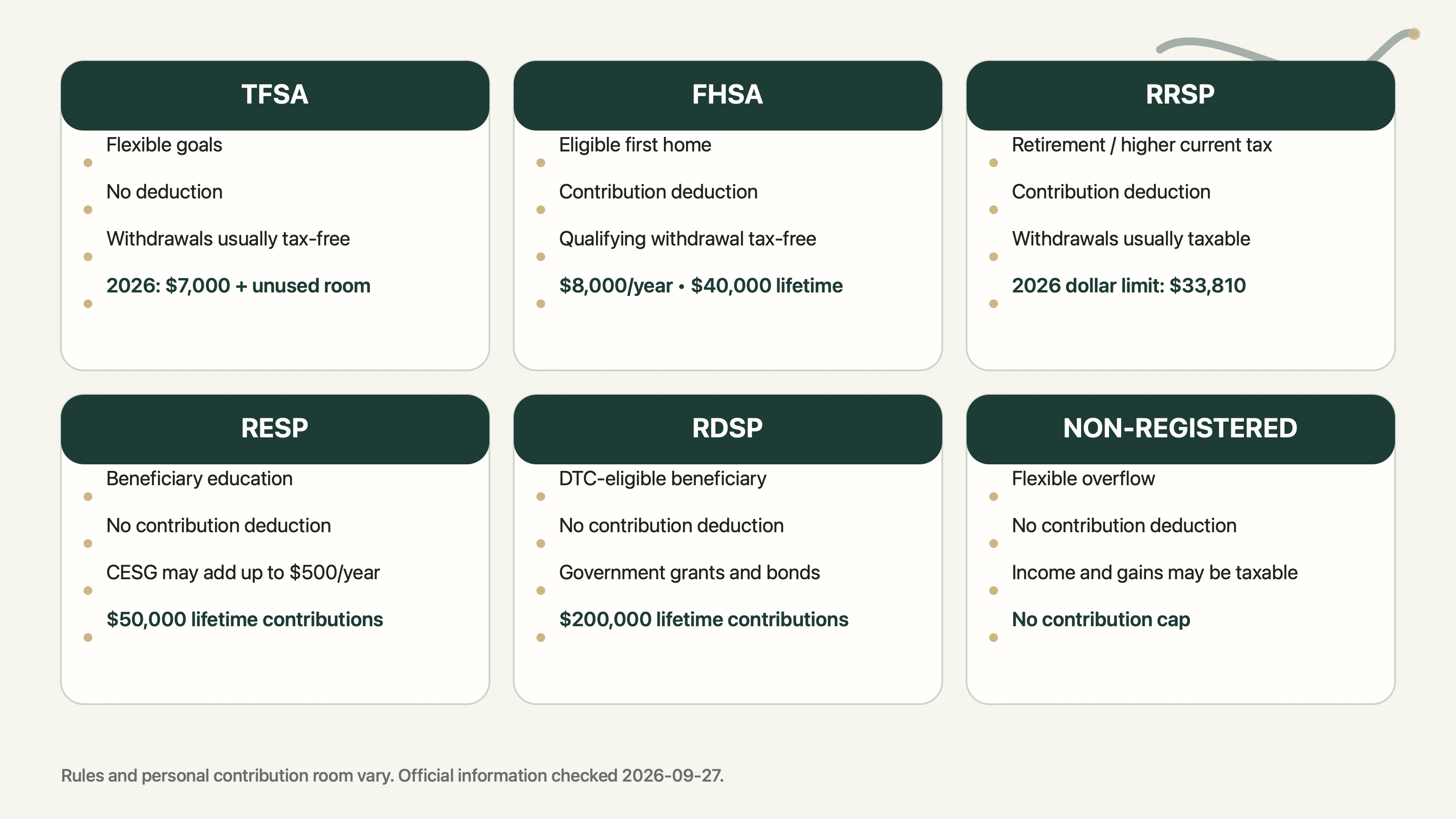 Six-card comparison of TFSA, FHSA, RRSP, RESP, RDSP, and non-registered accounts showing their common purpose, deduction treatment, withdrawal or tax treatment, and selected 2026 limits.
Figure 1. Canadian account comparison using rules checked September 27, 2026. Personal eligibility and contribution room can differ.
| Account | Usually best for | Deduction when contributing | Tax or withdrawal basics | Selected current limit |
|---|---|---|---|---|
| TFSA | Flexible goals | No | Growth and withdrawals are generally tax-free in Canada; withdrawals return as room next calendar year | 2026 dollar limit: $7,000, plus eligible unused room |
| FHSA | Eligible first-home buyers | Yes, subject to rules | Qualifying home withdrawal is generally tax-free | $8,000 in the first year opened; $40,000 lifetime |
| RRSP | Retirement, especially when the current tax rate is high | Yes, up to available deduction room | Growth is tax-deferred; regular withdrawals are generally taxable | 2026 RRSP dollar limit: $33,810; personal room may differ |
| RESP | A beneficiary's education | No | Government incentives and tax-deferred growth; education payments can be taxable to the student | $50,000 lifetime contributions per beneficiary; basic CESG usually up to $500 a year and $7,200 lifetime |
| RDSP | A Disability Tax Credit eligible beneficiary | No | Government grants and bonds may apply; withdrawal rules are more complex | $200,000 lifetime contributions; grants up to $70,000 lifetime and bonds up to $20,000 lifetime |
| Non-registered | Savings beyond registered room or needs that do not fit another account | No | Interest, dividends, and realized gains may be taxable | No contribution limit |
These are account rules, not investment choices. A five-year home deposit and a thirty-year retirement fund should not automatically hold the same investments.
A practical order of questions
- Do you have expensive debt and a cash emergency reserve? Build the base before taking market risk with money you may need soon.
- Does your employer match a pension or group RRSP contribution? Read the plan and consider capturing the full match.
- Are you eligible for RDSP grants or bonds? These benefits can matter more than a normal TFSA-versus-RRSP comparison.
- Are you saving for a child and eligible for RESP incentives? Capture grants without sacrificing your own basic financial stability.
- Are you an eligible first-home buyer with a real purchase goal? Compare FHSA and TFSA together.
- Is your current marginal tax rate high and the money for retirement? Compare RRSP with TFSA.
- Have the useful registered accounts been filled? Then consider a non-registered account.
This is a question order, not one fixed ranking for everyone.
Why FHSA plus TFSA can work well
An FHSA can offer an RRSP-like contribution deduction and a tax-free qualifying withdrawal for a first home. The 2026 annual participation room begins at $8,000 when the first FHSA is opened, with a $40,000 lifetime limit.
A TFSA does not give a contribution deduction, but it is much more flexible. A home buyer may need money for closing costs, moving, repairs, furniture, or a changed plan. TFSA withdrawals are generally tax-free in Canada, and the amount withdrawn returns as contribution room the next calendar year.
John's view: for someone who qualifies and expects to buy a first home, using an FHSA for the home goal and a TFSA for flexibility can be a strong combination. It will not fit every person or every timeline.
FHSA eligibility is more specific than simply saying, "I do not own a house today." Check the CRA first-time home buyer test before opening or withdrawing.
When RRSP becomes more attractive
An RRSP contribution can reduce taxable income. That may lower the marginal tax rate applied to part of your income, but it does not make the money permanently tax-free. Growth is tax-deferred while it remains in the account, and regular withdrawals are generally taxable later.
RRSP can be especially useful when:
- your current marginal tax rate is high;
- you expect a lower tax rate when withdrawing;
- you have a long time for tax-deferred compounding;
- an employer provides a match; or
- you will reinvest the tax refund instead of spending it.
If income is low today and likely to rise, TFSA may be more flexible. You can also contribute to an RRSP and claim the deduction in a later year, subject to the rules.
The U.S. dividend point
The Canada-U.S. tax treaty can protect qualifying RRSPs from U.S. withholding tax on dividends from direct U.S. securities or U.S.-listed ETFs. That benefit may not flow through the same way when an RRSP holds a Canadian-listed ETF that receives U.S. dividends inside the fund.
So "put U.S. dividends in an RRSP" is useful shorthand, but the product structure, listing, currency-conversion cost, fees, and future taxable RRSP withdrawal still matter.
RESP and RDSP can jump the queue
RESP and RDSP are not general-purpose personal accounts.
- A basic CESG can add 20% on the first $2,500 contributed to an RESP for an eligible beneficiary, usually up to $500 a year. Additional rules and grants may apply.
- An eligible RDSP can receive grants of up to $3,500 a year and $70,000 over a lifetime. A bond of up to $1,000 a year and $20,000 lifetime may be available without a personal contribution, depending on income and eligibility.
Because these benefits have eligibility and age rules, check them before automatically sending every extra dollar to TFSA or RRSP.
When a non-registered account belongs
A non-registered account has no contribution cap and no registered withdrawal rules. It also has no TFSA-style tax exemption or RRSP-style tax deferral. Investment income and realized gains may need to be reported, and adjusted cost base records matter.
It is often the next container after useful registered room is filled, not the automatic first account for a beginner.
Three mistakes to avoid
- Using the annual limit as your personal room. TFSA, RRSP, and FHSA room depends on your own history and eligibility.
- Choosing the account but ignoring the investment. Money needed soon should not automatically be placed in volatile assets.
- Spending an RRSP refund without comparing fairly. Much of the RRSP advantage depends on the deduction, long deferral, and what you do with the refund.
Where to begin
- Write the goal and the date the money may be needed.
- Check employer matching and benefit eligibility.
- Calculate your own contribution room from records and CRA information.
- Open one account that fits the first goal.
- Fund it slowly and keep transaction records.
- Review the order again when income, family, or housing plans change.
Disclaimer: This article is for education and entertainment only. It is not financial, tax, legal, or investment advice. Account eligibility, contribution room, grants, benefits, and tax results depend on individual facts. Verify current rules with the relevant government source or a qualified professional before acting.
Sources
- Canada Revenue Agency, "Calculate your TFSA contribution room": https://www.canada.ca/en/revenue-agency/services/tax/individuals/topics/tax-free-savings-account/contributing/calculate-room.html
- Canada Revenue Agency, "Withdrawing from a TFSA": https://www.canada.ca/en/revenue-agency/services/tax/individuals/topics/tax-free-savings-account/withdraw.html
- Canada Revenue Agency, "Opening your FHSAs": https://www.canada.ca/en/revenue-agency/services/tax/individuals/topics/first-home-savings-account/opening-your-fhsas.html
- Canada Revenue Agency, "Participating in your FHSAs": https://www.canada.ca/en/revenue-agency/services/tax/individuals/topics/first-home-savings-account/contributing-your-fhsa.html
- Canada Revenue Agency, "RRSP deduction limits": https://www.canada.ca/en/revenue-agency/services/tax/individuals/topics/rrsps-related-plans/contributing-a-rrsp-prpp/contributions-affect-your-rrsp-prpp-deduction-limit.html
- Canada Revenue Agency, "RESP contributions": https://www.canada.ca/en/revenue-agency/services/tax/individuals/topics/registered-education-savings-plans-resps/resp-contributions.html
- Employment and Social Development Canada, "Estimating education savings amounts": https://www.canada.ca/en/services/benefits/education/education-savings/estimating-amounts.html
- Employment and Social Development Canada, "RDSP grants and bonds": https://www.canada.ca/en/employment-social-development/programs/disability/savings/how-much.html
- Department of Finance Canada, "Canada-United States Tax Convention": https://www.canada.ca/en/department-finance/programs/tax-policy/tax-treaties/country/united-states-america-convention-consolidated-1980-1983-1984-1995-1997-2007.html
- BlackRock Canada, "Withholding Tax Reference Guide": https://www.blackrock.com/ca/investisseurs/fr/literature/brochure/withholding-tax-reference-guide-en-ca.pdf
Publication gate
BLOCKED_PUBLICATION: Requires John's exact-revision approval plus Canadian tax, legal, investment, and Korean-language review. All current limits must be rechecked within seven days of publication.
Co-authored and managed by John Park and his team of AI agents, orchestrated by AXE.
Sources
- canada.cahttps://www.canada.ca/en/revenue-agency/services/tax/individuals/topics/tax-free-savings-account/contributing/calculate-room.html
- canada.cahttps://www.canada.ca/en/revenue-agency/services/tax/individuals/topics/tax-free-savings-account/withdraw.html
- canada.cahttps://www.canada.ca/en/revenue-agency/services/tax/individuals/topics/first-home-savings-account/opening-your-fhsas.html
- canada.cahttps://www.canada.ca/en/revenue-agency/services/tax/individuals/topics/first-home-savings-account/contributing-your-fhsa.html
- canada.cahttps://www.canada.ca/en/revenue-agency/services/tax/individuals/topics/first-home-savings-account/tax-deductions-fhsa-contributions.html
- canada.cahttps://www.canada.ca/en/revenue-agency/services/tax/individuals/topics/rrsps-related-plans/contributing-a-rrsp-prpp/contributions-affect-your-rrsp-prpp-deduction-limit.html
- canada.cahttps://www.canada.ca/en/revenue-agency/services/tax/individuals/topics/rrsps-related-plans/making-withdrawals.html
- canada.cahttps://www.canada.ca/en/revenue-agency/services/tax/individuals/topics/registered-education-savings-plans-resps/resp-contributions.html
- canada.cahttps://www.canada.ca/en/services/benefits/education/education-savings/estimating-amounts.html
- canada.cahttps://www.canada.ca/en/employment-social-development/programs/disability/savings/how-much.html
- canada.cahttps://www.canada.ca/en/employment-social-development/programs/disability/savings/contribute.html
- canada.cahttps://www.canada.ca/en/department-finance/programs/tax-policy/tax-treaties/country/united-states-america-convention-consolidated-1980-1983-1984-1995-1997-2007.html
- blackrock.comhttps://www.blackrock.com/ca/investisseurs/fr/literature/brochure/withholding-tax-reference-guide-en-ca.pdf
- canada.cahttps://www.canada.ca/en/revenue-agency/services/tax/individuals/topics/about-your-tax-return/tax-return/completing-a-tax-return/personal-income/investment-income.html
Korean original
Read the Korean original at /articles/which-canadian-investment-account-first-ko →