

Investing Is Not Trading: Time, Behaviour, and DCA
A short beginner's guide to compounding, investor behaviour, and dollar-cost averaging.
- Published
- 2026-09-28
- Last verified
- 2026-09-27
- Recheck by
- 2026-12-26
- Reading time
- 9 min read
- Revision
- rev.1
- Editorial approval
- Approved 2026-09-28
Co-authored and managed by John Park and his team of AI agents, orchestrated by AXE.
Investing Is Not Trading: Time, Behaviour, and DCA
 A restrained sumi-e Asian serpent follows a river through changing seasons while a person plants small trees at regular intervals on warm textured paper.
The Yimuki serpent follows time while regular planting continues through every season. Conceptual art only.
1. The lesson that stayed
John wishes personal finance had been taught in high school. One math teacher did show him compounding, and that lesson sparked his interest in investing.
Later, an industry course gave him names for common habits, including home bias and buyer's remorse. Knowing the words does not remove the habits, but it makes them easier to notice.
2. Investing is not trading
- Investing means owning productive assets and giving them time.
- Trading tries to profit from shorter-term price moves.
- Speculation depends heavily on what someone may pay next.
- Gambling is built around a house edge.
These activities can use the same app and the same buy button, but they are not the same plan. Investing can still lose money. Time reduces no risk to zero.
3. Behaviour matters
 A sumi-e garden on warm paper where familiar paths, mirrors, anchors, a crowded flock, and returning weeds symbolize investor biases, with a subtle Asian serpent winding calmly around the garden edge.
Biases are like weeds. They return unless the plan accounts for them. Conceptual art only.
Common habits include:
- Home bias: owning too much of what feels familiar, such as your home country or employer.
- Loss aversion: reacting more strongly to a loss than to an equal gain.
- Buyer's remorse: regretting a purchase soon after making it.
- Recency bias: assuming the recent past will continue.
- Confirmation bias: noticing evidence that agrees with you and ignoring the rest.
- FOMO and herd behaviour: following other people after prices have already moved.
- Action bias: changing the plan because doing something feels better than waiting.
An older U.S. study followed more than 60,000 brokerage households from February 1991 to December 1996. The average household earned 17.7% before trading costs and 15.3% after them. The most active 20% earned 10.0% net. It was one study from one period, but it shows why activity and costs deserve attention.
A written plan and automatic contributions reduce the number of decisions you must make when markets feel frightening.
4. Compounding rewards time
Compounding means returns can earn returns. The longer the process continues, the more time matters.
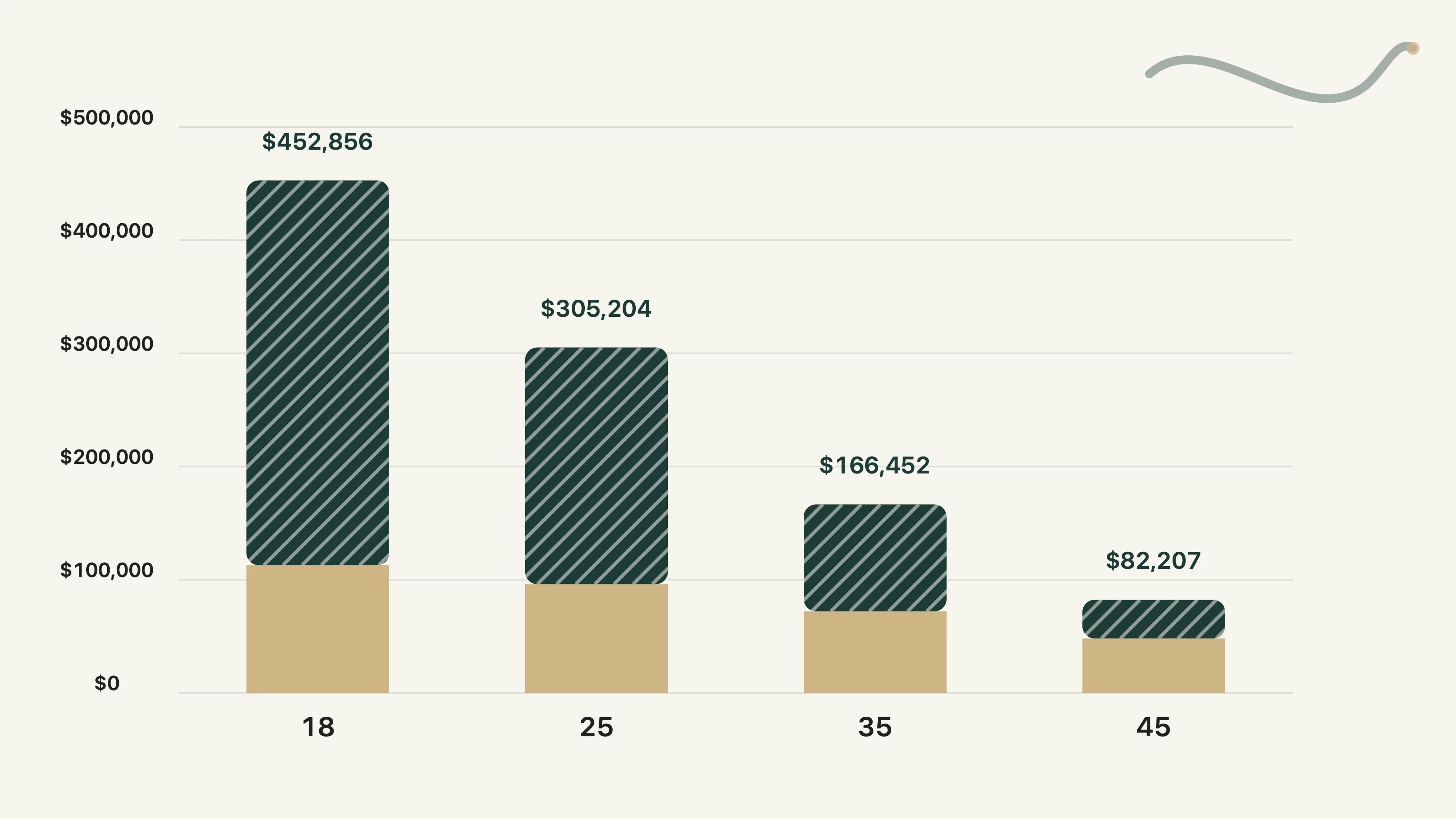 Stacked bar chart showing the hypothetical value at age 65 of two hundred Canadian dollars invested at each month end, for starting ages 18, 25, 35, and 45, with the contributed portion and the hypothetical growth portion shown as separate stacked segments.
Figure 1. CAD $200 invested monthly until age 65. Hypothetical arithmetic, not a forecast.
Source: Yimuki calculation using the future value of an ordinary annuity formula.
Assumptions: 5% nominal annual return compounded monthly, before fees, tax, and inflation. Real returns are uneven and may be negative.
Verified: 2026-09-27.
| Starting age | Total contributed | Hypothetical value at 65 | Hypothetical growth |
|---|---|---|---|
| 18 | $112,800 | $452,856 | $340,056 |
| 25 | $96,000 | $305,204 | $209,204 |
| 35 | $72,000 | $166,452 | $94,452 |
| 45 | $48,000 | $82,207 | $34,207 |
The lesson is simple: starting sooner gives money more time to compound. The numbers are an illustration, not a promised result.
5. A longer horizon helped in one historical dataset
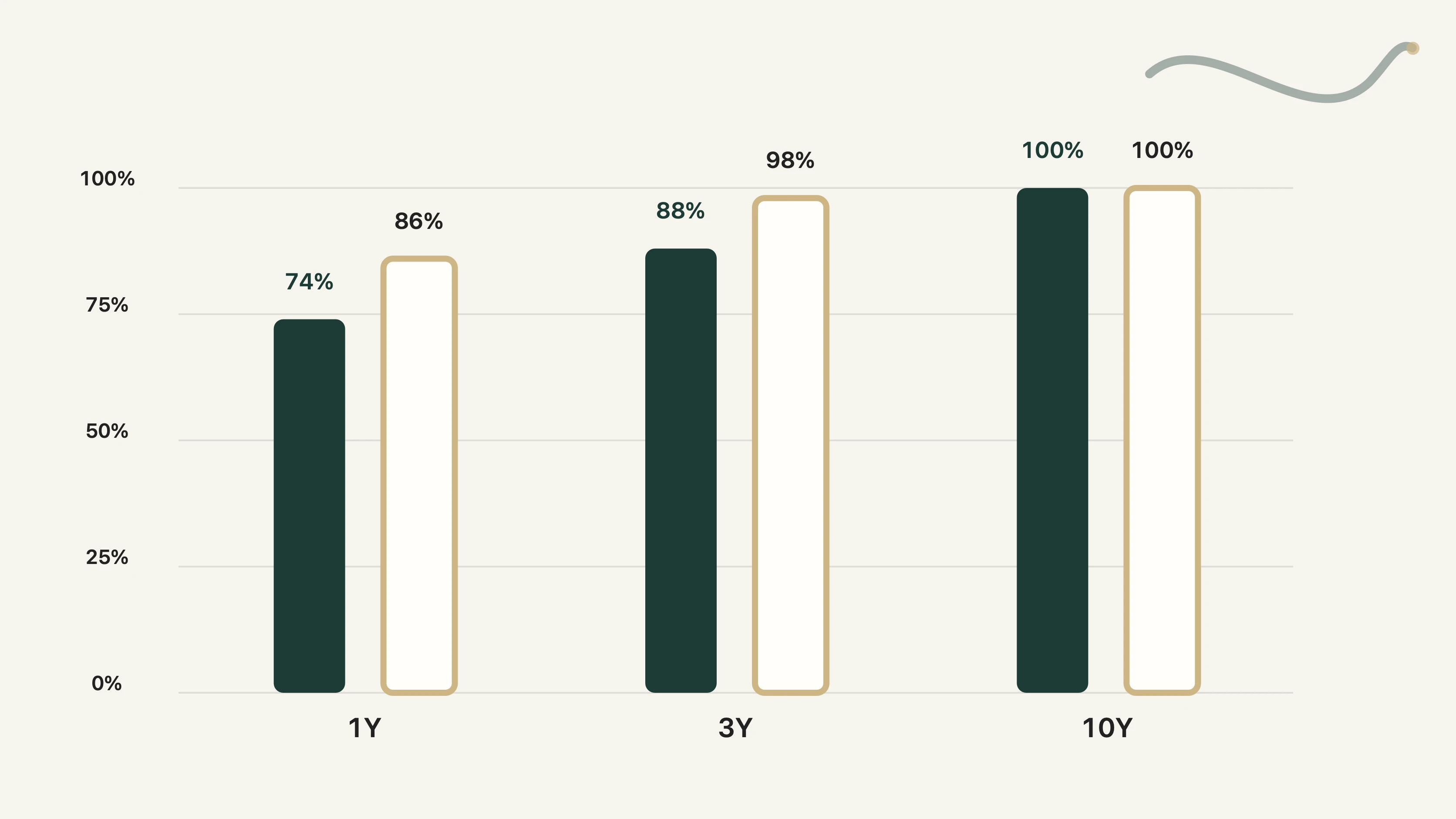 Grouped bar chart showing the share of rolling historical periods that ended positive, for 1-year, 3-year, and 10-year holding periods, comparing Canadian stocks at 74, 88, and 100 percent with an illustrated balanced portfolio at 86, 98, and 100 percent.
Figure 2. Share of rolling periods that ended positive in one Canadian historical dataset.
Source: Ontario Securities Commission / GetSmarterAboutMoney, Time and Risk 2026.
Assumptions: Data begin in 1935 and end at the latest year end available in the source. Reinvestment is assumed. Taxes and transaction costs are excluded.
Verified: 2026-09-27.
| Holding period | Canadian stocks | Illustrated balanced portfolio |
|---|---|---|
| 1 year | 74% | 86% |
| 3 years | 88% | 98% |
| 10 years | 100% | 100% |
Longer periods ended positive more often in this dataset. That does not mean long-term investing always wins. Past data cannot promise a future result, and a long holding period can still include large declines.
6. Dollar-cost averaging
Dollar-cost averaging, or DCA, means investing the same amount on a regular schedule.
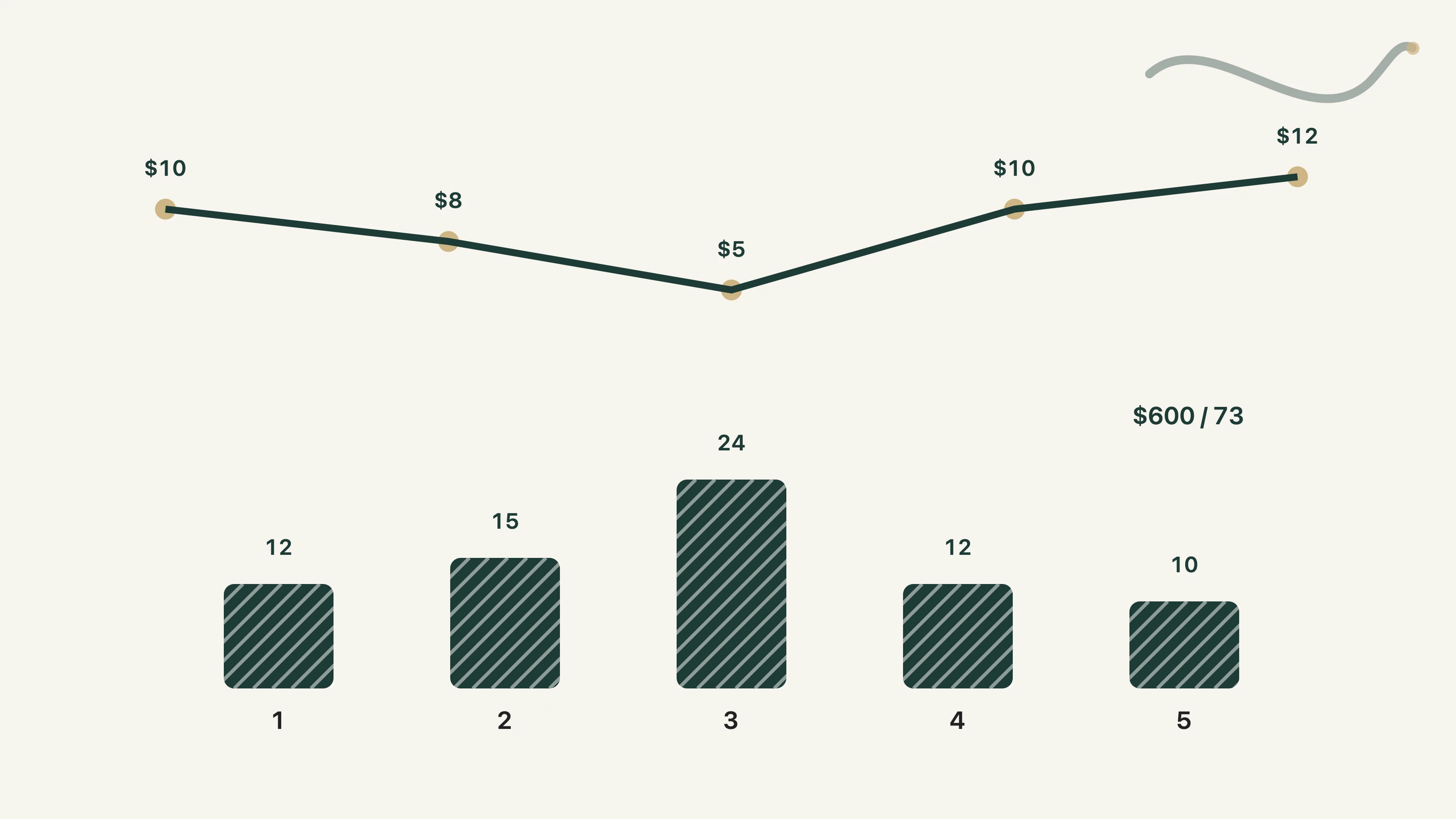 Bar chart showing a fixed one-hundred-and-twenty-dollar contribution buying more synthetic units when the illustrated price is lower and fewer when it is higher across five periods.
Figure 3. Fixed contributions with invented prices. Teaching arithmetic only.
Source: Yimuki arithmetic illustration.
Assumptions: Invented prices, no fees, spreads, commissions, or taxes.
Verified: 2026-09-27.
| Period | Invented unit price | Contribution | Units bought |
|---|---|---|---|
| 1 | $10 | $120 | 12 |
| 2 | $8 | $120 | 15 |
| 3 | $5 | $120 | 24 |
| 4 | $10 | $120 | 12 |
| 5 | $12 | $120 | 10 |
| Total | $600 | 73 |
The average price is about $8.22. At the invented final price of $12, the 73 units are worth $876. This example favours DCA because prices fall in the middle. DCA does not guarantee a profit. Its main benefit is making the contribution decision automatic.
Investing money from each paycheque is also different from slowly investing a lump sum you already hold. The second choice keeps some money out of the market and is partly a timing decision.
John's approach
John's baseline DCA never stops. During major economic and market downturns, he worked more and invested more of that additional income. When markets feel expensive, he may reduce the extra amount, not the baseline.
This is partly market timing. John says it has worked well for allocating his own funds. It is his opinion and experience, may not work every time, and is not proof of outperformance.
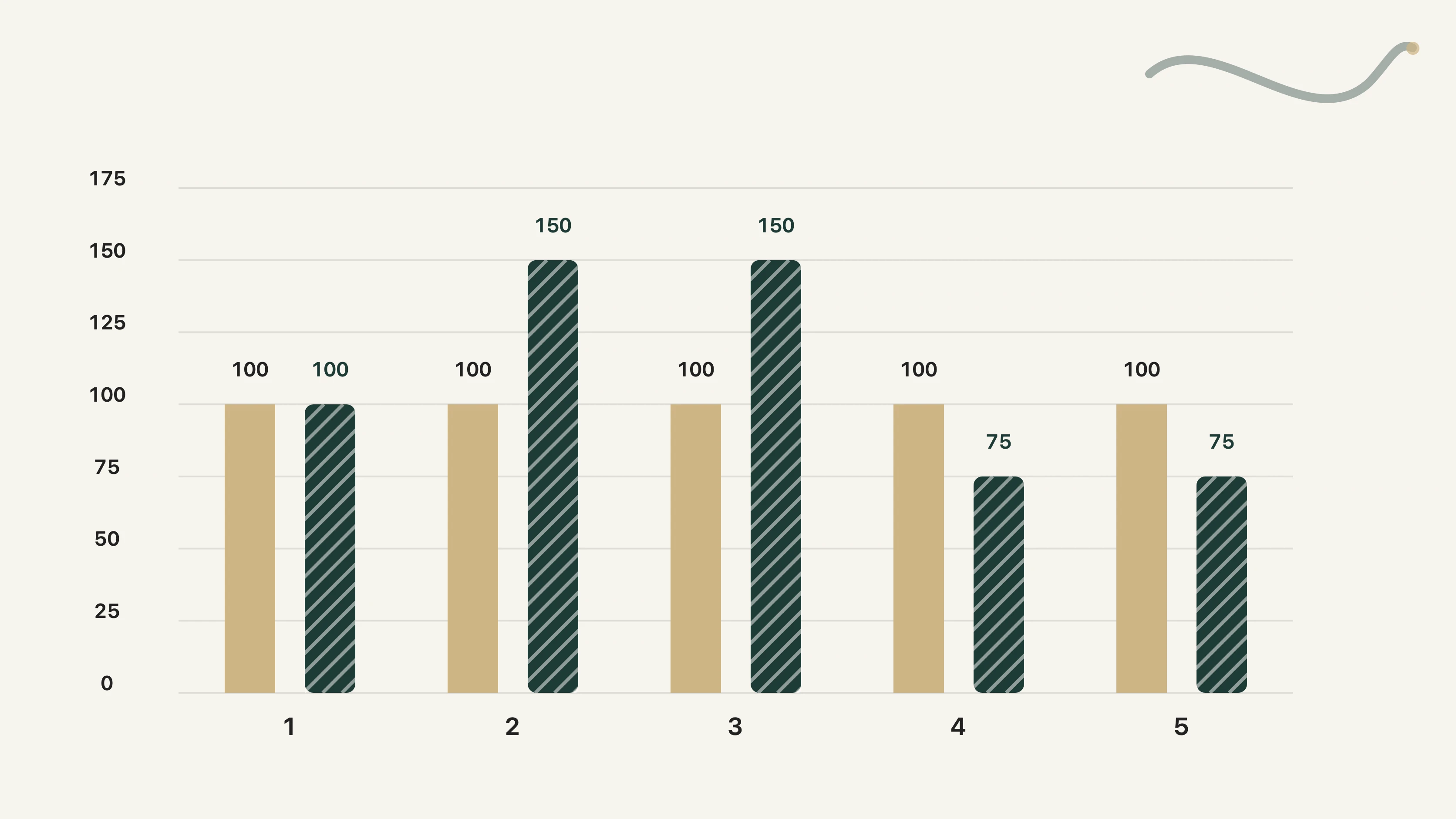 Grouped bar diagram comparing contribution size only across five periods, where the fixed plan contributes one hundred normalized units every period and a hypothetical variable plan contributes one hundred, one hundred and fifty, one hundred and fifty, seventy-five, and seventy-five units, never zero.
Figure 4. Contribution size only. No prices, returns, or outcomes are shown.
| Period | Example condition | Fixed contribution | Variable contribution |
|---|---|---|---|
| 1 | Normal | 100 | 100 |
| 2 | Broad decline | 100 | 150 |
| 3 | Broad decline | 100 | 150 |
| 4 | Expensive by the rule | 100 | 75 |
| 5 | Expensive by the rule | 100 | 75 |
| Total | 500 | 550 |
The chart only shows that a variable plan needs more cash during declines. It does not show which plan earns more.
7. Where to begin
- Keep emergency money separate from investment money.
- Deal with expensive debt.
- Write down what the money is for and when you may need it.
- Choose an account, platform, and diversified investment you understand.
- Set a contribution you can keep making in a bad month.
- Automate it, keep records, and review the plan when your life changes, not when a headline scares you.
8. Four useful books
- Morgan Housel, The Psychology of Money: why behaviour matters as much as knowledge.
- Carl Richards, The Behavior Gap: how investor reactions can damage results.
- John C. Bogle, The Little Book of Common Sense Investing: broad diversification, low costs, and patience.
- Michael E. Edleson, Value Averaging: a formula-based variable-contribution method that is different from John's approach.
Bottom line
Start when you can. Keep the plan simple. Give compounding time, and make fewer decisions when emotions are high.
Sources
- Ontario Securities Commission / GetSmarterAboutMoney, "Familiarity bias": https://www.getsmarteraboutmoney.ca/learning-path/psychology-of-investing/familiarity-bias/
- Ontario Securities Commission / GetSmarterAboutMoney, "How a fear of losing can affect your financial decisions": https://www.getsmarteraboutmoney.ca/learning-path/psychology-of-investing/how-a-fear-of-losing-can-affect-your-financial-decisions/
- Ontario Securities Commission / GetSmarterAboutMoney, "The powerful impact anchoring has on your decisions": https://www.getsmarteraboutmoney.ca/learning-path/psychology-of-investing/the-powerful-impact-anchoring-has-on-your-decisions/
- Ontario Securities Commission / GetSmarterAboutMoney, "What is an investment time horizon?": https://www.getsmarteraboutmoney.ca/learning-path/understanding-risk/what-is-an-investment-time-horizon/
- Ontario Securities Commission / GetSmarterAboutMoney, "Time and Risk 2026" (PDF): https://www.getsmarteraboutmoney.ca/app/uploads/2026/03/TIME-AND-RISK-2026.pdf
- U.S. Securities and Exchange Commission, Investor.gov, "Dollar cost averaging": https://www.investor.gov/introduction-investing/investing-basics/glossary/dollar-cost-averaging
- U.S. Securities and Exchange Commission, Investor.gov, "Compound interest calculator": https://www.investor.gov/financial-tools-calculators/calculators/compound-interest-calculator
- FINRA, "Dollar-Cost Averaging": https://www.finra.org/investors/insights/dollar-cost-averaging
- FINRA, "Market Timing": https://www.finra.org/investors/insights/market-timing
- Brad M. Barber and Terrance Odean, University of California, Berkeley, "Trading Is Hazardous to Your Wealth" (abstract): https://faculty.haas.berkeley.edu/odean/papers/returns/returns.html
- Vanguard Investments Canada, "Best practices for behavioural coaching" (PDF): https://www.vanguard.ca/content/dam/intl/americas/canada/en/documents/gas/best-practices-behavioral-coaching.pdf
- CFA Institute Research Foundation, "Behavioral Finance: The Second Generation" (PDF): https://www.cfainstitute.org/-/media/documents/book/rf-publication/2019/behavioral-finance-the-second-generation.pdf
Further reading
- Morgan Housel, The Psychology of Money: https://www.panmacmillan.com/authors/morgan-housel/the-psychology-of-money/9781804091609
- Carl Richards, The Behavior Gap: https://www.penguinrandomhouse.com/books/310366/the-behavior-gap-by-carl-richards/
- John C. Bogle, The Little Book of Common Sense Investing: https://www.wiley.com/en-ca/The+Little+Book+of+Common+Sense+Investing%3A+The+Only+Way+to+Guarantee+Your+Fair+Share+of+Stock+Market+Returns%2C+Updated+and+Revised-p-9781119404507
- Michael E. Edleson, Value Averaging: https://www.wiley-vch.de/en?option=com_eshop&view=product&isbn=9780470049778&title=Value%20Averaging
Co-authored and managed by John Park and his team of AI agents, orchestrated by AXE.
Editorial gate
BLOCKED_PUBLICATION: This exact revision still requires John's approval and Korean, legal, tax, securities, and investment review.
Sources
- getsmarteraboutmoney.cahttps://www.getsmarteraboutmoney.ca/learning-path/psychology-of-investing/familiarity-bias/
- getsmarteraboutmoney.cahttps://www.getsmarteraboutmoney.ca/learning-path/psychology-of-investing/how-a-fear-of-losing-can-affect-your-financial-decisions/
- getsmarteraboutmoney.cahttps://www.getsmarteraboutmoney.ca/learning-path/psychology-of-investing/the-powerful-impact-anchoring-has-on-your-decisions/
- getsmarteraboutmoney.cahttps://www.getsmarteraboutmoney.ca/learning-path/understanding-risk/what-is-an-investment-time-horizon/
- getsmarteraboutmoney.cahttps://www.getsmarteraboutmoney.ca/app/uploads/2026/03/TIME-AND-RISK-2026.pdf
- investor.govhttps://www.investor.gov/introduction-investing/investing-basics/glossary/dollar-cost-averaging
- investor.govhttps://www.investor.gov/financial-tools-calculators/calculators/compound-interest-calculator
- finra.orghttps://www.finra.org/investors/insights/dollar-cost-averaging
- finra.orghttps://www.finra.org/investors/insights/market-timing
- faculty.haas.berkeley.eduhttps://faculty.haas.berkeley.edu/odean/papers/returns/returns.html
- vanguard.cahttps://www.vanguard.ca/content/dam/intl/americas/canada/en/documents/gas/best-practices-behavioral-coaching.pdf
- cfainstitute.orghttps://www.cfainstitute.org/-/media/documents/book/rf-publication/2019/behavioral-finance-the-second-generation.pdf
Korean original
Read the Korean original at /articles/investing-mindset-behavior-dca-ko →