

How to Choose a Canadian Investing Platform
A plain look at the four common ways Canadians open and manage an investing account, so you can match the path to how you want to invest instead of chasing a single winner.
- Published
- 2026-09-28
- Last verified
- 2026-09-27
- Recheck by
- 2026-12-26
- Reading time
- 9 min read
- Revision
- rev.1
- Editorial approval
- Approved 2026-09-28
Co-authored and managed by John Park and his team of AI agents, orchestrated by AXE.
How to Choose a Canadian Investing Platform
Every Canadian investing account has to be opened somewhere. The four common paths below trade advice, control, and cost against each other in different ways, and none of them is the automatic right choice for everyone.
 A cream container holding several different investment objects rests on a deep-green platform, showing that a platform, an account, and investments are separate layers.
This lesson focuses on the platform layer: how and where an account gets opened and managed. Reused unmodified from the Step 1 cornerstone illustration. Conceptual art only, not a ranking of any platform.
The four paths
Managed or robo-adviser
An algorithm, usually paired with a small human team, builds and manages a portfolio around a risk profile the investor selects during onboarding. Contributions, rebalancing, and often dividend reinvestment are handled automatically. This path sits between fully self-directed investing and full human advice: it is more guided than picking your own securities, but it is not a personalized financial plan built around your full situation.
Independent self-directed brokerage
An online, order-execution-focused (OEO) brokerage where the investor selects and trades individual stocks, ETFs, or mutual funds directly. CIRO describes these accounts as investor-directed, meaning the firm does not give a personalized recommendation or run a suitability assessment on individual trades. Independent self-directed brokerages are not affiliated with a bank's retail branch network.
Bank-owned direct brokerage
The same self-directed, investor-directed category as above, but operated by one of Canada's banks and usually accessed alongside everyday chequing, savings, and credit products. The trading experience is still self-directed: no personalized recommendation comes bundled with the account by default.
Human adviser
A registered individual may build a personalized plan, recommend specific investments, and generally runs a suitability assessment against your goals, time horizon, and risk tolerance. Services vary by adviser. This path offers more guidance and less day-to-day work for the investor, and it usually costs more directly than a self-directed account.
Comparing the four paths
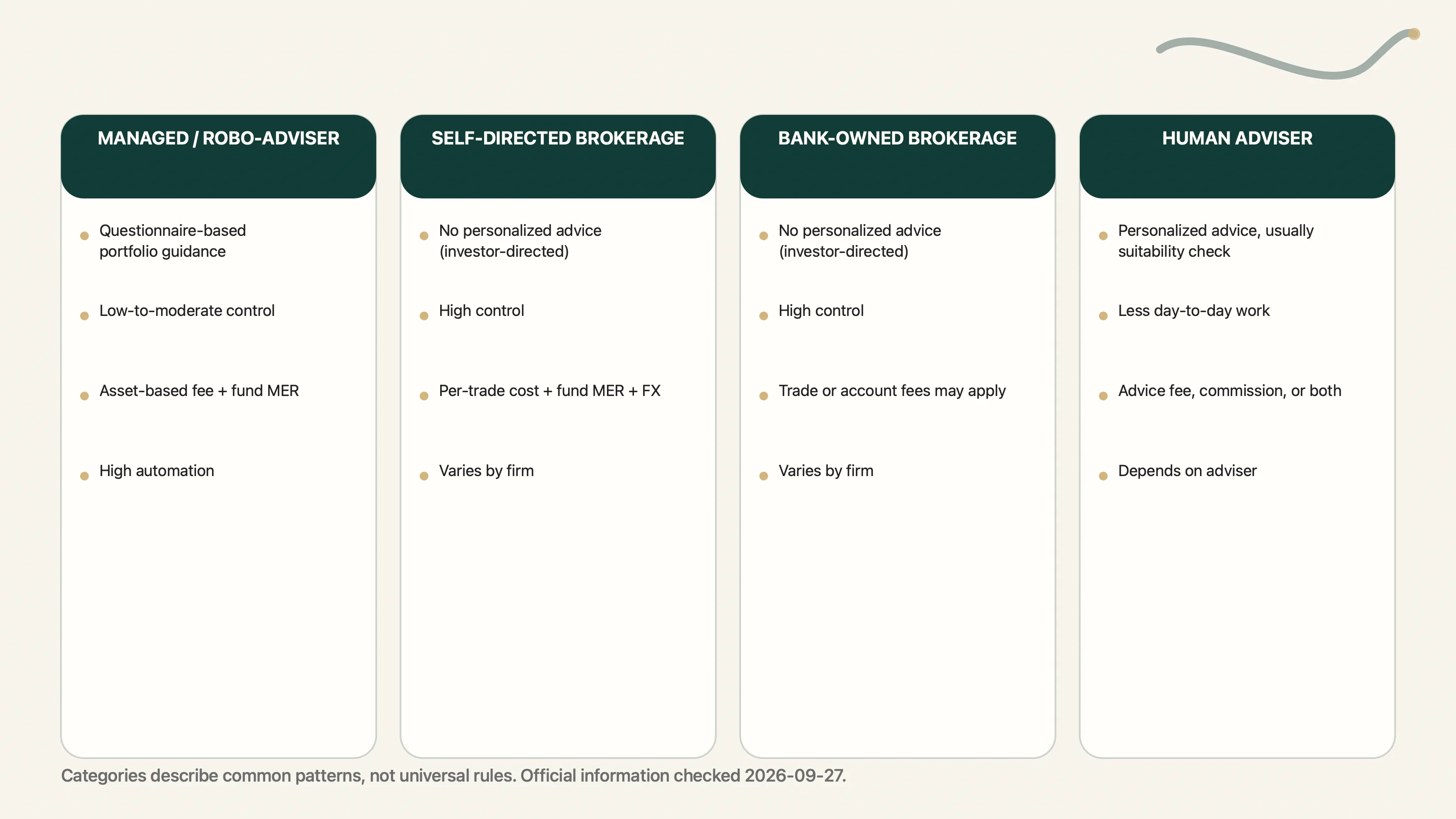 Four-card comparison of managed/robo-adviser, independent self-directed brokerage, bank-owned direct brokerage, and human adviser paths across advice, control, typical cost structure, automation, and complexity.
Figure 1. Four common ways to access a Canadian investing account, compared using categories checked September 27, 2026. This is not a ranking.
| Path | Advice | Control | Typical cost structure | Automation | Complexity | May suit |
|---|---|---|---|---|---|---|
| Managed/robo-adviser | Algorithm-driven portfolio management with limited personalization | Low to moderate; you choose a risk profile, not individual securities | An asset-based management fee plus underlying fund MER | High; rebalancing and contributions are usually automatic | Low; account setup and ongoing management are largely automated | Someone who wants a diversified portfolio without picking investments themselves |
| Independent self-directed brokerage | None; CIRO classifies this as investor-directed with no personalized recommendation or suitability check | High; you select and trade individual securities | Per-trade commissions (often $0 on stocks and ETFs at several firms), plus fund MER on anything held and FX costs | Varies by firm; some offer recurring investment tools, others do not | Higher; you choose investments, order types, and when to rebalance | Someone comfortable researching and managing their own portfolio |
| Bank-owned direct brokerage | None; same investor-directed category as above | High; same self-directed trading control | Per-trade or account fees may apply, plus fund MER and FX costs | Varies by firm | Higher; same self-directed responsibility | Someone who wants self-directed investing next to their existing bank accounts |
| Human adviser | Personalized recommendations and typically a suitability assessment | Less day-to-day work; you still decide whether to accept the advice | An advice or management fee, a commission, or a combination, depending on registration category | Depends on the adviser and firm | Lower hands-on workload, but the service and fees still need review | Someone who wants ongoing personalized guidance and is comfortable paying for it |
This is a comparison of categories, not a ranking. A specific firm can differ from its category's general pattern, and offers change over time.
A dated snapshot of Canadian providers (checked September 27, 2026)
These are named as dated examples of firms operating in each category, not endorsements and not a ranking. Verify current terms directly at the official page before opening an account.
| Provider | Category | Selected commission | Selected other fee |
|---|---|---|---|
| Wealthsimple | Independent self-directed brokerage | $0 online commission on listed Canadian and U.S. securities | CAD account currency conversion fee: 1.5%. USD-account conversions are tiered; the Core USD account fee is $10 plus tax monthly on the published schedule |
| Questrade | Independent self-directed brokerage | $0 online stock and ETF commissions | See the official pricing page for current FX and account details |
| Qtrade Direct Investing | Independent self-directed brokerage | $0 online commissions for stocks, ETFs, and mutual funds | See the official commission and fee schedule for current account details |
| National Bank Direct Brokerage | Bank-owned direct brokerage | $0 online commissions for Canadian and U.S. stocks and ETFs | $100 annual administration fee, with stated exemptions including $20,000 in eligible assets or age 30 or under |
| RBC Direct Investing | Bank-owned direct brokerage | $9.95 standard online stock/ETF trade, plus a selection of $0-commission ETFs | GoSmart offer: 50 commission-free trades per year for eligible new-investor accounts |
| Interactive Brokers Canada | Independent self-directed brokerage | Fixed and tiered per-share commissions | Separate, low spot-FX pricing; its interface and pricing are more layered than a single headline number |
Costs beginners often miss
- Trade commissions. The per-order fee to buy or sell a stock or ETF. Several self-directed brokerages now charge $0 online, but confirm this applies to your order type and market first.
- Fund MER. The management expense ratio is an ongoing percentage charged inside an ETF or mutual fund, deducted from returns rather than billed separately. It applies no matter which platform holds the fund.
- Managed or advice fee. A robo-adviser's asset-based management fee, or a human adviser's advice fee or commission, comes on top of any underlying fund MER.
- FX conversion. Converting CAD to USD to buy a U.S.-listed security carries a cost. Wealthsimple's published CAD-account conversion fee, for example, is 1.5%; other platforms set their own schedules.
- Account or admin fees. Some bank-owned brokerages charge an annual admin fee, sometimes waived above an asset threshold or under an age exemption. Confirm the exact current terms.
- Transfer-out fees. Moving to a different provider can carry a fee from the firm you are leaving. Check this before opening an account you may want to move later.
- Bid-ask spread. The gap between what a buyer will pay and a seller will accept is an implicit cost on every trade, separate from any commission, and it tends to widen for thinly traded securities.
Automation, fractional shares, and why convenience can matter
For a beginner, a platform that automates a modest, sustainable contribution is often more useful than one with the most advanced feature set. Several Canadian platforms publish official instructions for setting up a recurring investment that buys on a schedule without a manual order each time. Whether a platform supports buying a fractional share (a partial unit) as part of that automation depends on the platform and the security, so check your own platform's official terms rather than assuming a feature applies everywhere.
Automation does not remove the need to understand what you are buying or what it costs. It reduces the chance that a plan quietly stops because remembering to place an order each month is inconvenient.
Registration and CIPF: a safety layer, not a performance promise
Before opening an account or accepting a recommendation, verify the firm or individual through the official CIRO and CSA registration tools, such as the CSA's "Are they registered?" search. An unregistered person offering investment advice is a warning sign on its own.
CIPF protects eligible missing cash, securities, and other property if a CIPF member firm becomes insolvent, subject to policy limits, for accounts held at member firms. It does not cover a decline in the market value of your investments, and it does not make an investment itself safe. You can check whether a specific firm is a current CIPF member using the official member directory.
A short decision path
- Do I want an ongoing personalized recommendation, or am I comfortable deciding on my own? This is the main line between advised and self-directed paths.
- How much time do I want to spend actively managing the account? More automation generally means less day-to-day involvement.
- Do I already bank somewhere I would want to keep my investing account alongside? This can point toward a bank-owned brokerage, though it is not required.
- Do I want contributions and rebalancing handled for me? This points toward managed or robo-advice rather than a fully self-directed account.
- Am I comfortable comparing several fee types myself, or would a single advice fee feel simpler to track? This affects how much homework the cost comparison above will take.
This is a question order to work through, not a formula with one correct answer.
Before you open anything
- Write down whether you want personalized advice or are comfortable deciding yourself.
- List the fee types above and check the official current numbers for any platform you are considering.
- Confirm the firm or adviser is currently registered using the CSA or CIRO tools.
- Check whether the firm is a current CIPF member and understand what that coverage does and does not do.
- Read the platform's own page on recurring investments if automation matters to you.
Next step: Lesson 5 walks through building a diversified ETF portfolio once an account and a platform are in place.
Disclaimer: This article is for education and entertainment only. It is not financial, tax, legal, or investment advice. Fees, features, eligibility, and registration status change over time and depend on individual facts. Verify current terms with the relevant official source or a qualified professional before acting.
Sources
- CIRO, "DIY vs. advised investing: which is right for you?": https://www.ciro.ca/office-investor/investing-basics/diy-vs-advised-investing-which-right-you
- CIPF, "About CIPF coverage": https://www.cipf.ca/cipf-coverage/about-cipf-coverage
- CIPF, "Current CIPF members": https://www.cipf.ca/member-directory/current-cipf-members
- Wealthsimple, "Fees": https://www.wealthsimple.com/en-ca/legal/fees/trade
- Wealthsimple Help Centre, "Set up a recurring investment": https://help.wealthsimple.com/hc/en-ca/articles/9544942923547-Set-up-a-recurring-investment
- Questrade, "Self-directed commissions, plans and fees": https://www.questrade.com/pricing/self-directed-commissions-plans-fees
- Questrade, "Understanding recurring investments": https://www.questrade.com/learning/understanding-recurring-investments
- Qtrade, "Pricing": https://www.qtrade.ca/en/investor/pricing.html
- Qtrade, "Commission and fee schedule": https://www.qtrade.ca/en/investor/client-site/commission-and-fee-schedule.html
- National Bank Direct Brokerage, "Pricing": https://nbdb.ca/pricing.html
- RBC Direct Investing, "Pricing": https://www.rbcdirectinvesting.com/pricing/index.html
- Interactive Brokers Canada, "Commissions": https://www.interactivebrokers.ca/en/pricing/commissions-home.php
- Interactive Brokers Canada, "FX pricing": https://www.interactivebrokers.ca/en/index.php?f=49654
- Canadian Securities Administrators, "Are they registered?": https://www.aretheyregistered.ca/
Publication gate
BLOCKED_PUBLICATION: Requires John's exact-revision approval plus Canadian legal, investment, and Korean-language review. All current fees and registration details must be rechecked within seven days of publication.
Co-authored and managed by John Park and his team of AI agents, orchestrated by AXE.
Sources
- ciro.cahttps://www.ciro.ca/office-investor/investing-basics/diy-vs-advised-investing-which-right-you
- cipf.cahttps://www.cipf.ca/cipf-coverage/about-cipf-coverage
- cipf.cahttps://www.cipf.ca/member-directory/current-cipf-members
- wealthsimple.comhttps://www.wealthsimple.com/en-ca/legal/fees/trade
- help.wealthsimple.comhttps://help.wealthsimple.com/hc/en-ca/articles/9544942923547-Set-up-a-recurring-investment
- questrade.comhttps://www.questrade.com/pricing/self-directed-commissions-plans-fees
- questrade.comhttps://www.questrade.com/learning/understanding-recurring-investments
- qtrade.cahttps://www.qtrade.ca/en/investor/pricing.html
- qtrade.cahttps://www.qtrade.ca/en/investor/client-site/commission-and-fee-schedule.html
- nbdb.cahttps://nbdb.ca/pricing.html
- rbcdirectinvesting.comhttps://www.rbcdirectinvesting.com/pricing/index.html
- interactivebrokers.cahttps://www.interactivebrokers.ca/en/pricing/commissions-home.php
- interactivebrokers.cahttps://www.interactivebrokers.ca/en/index.php?f=49654
- aretheyregistered.cahttps://www.aretheyregistered.ca/
Korean original
Read the Korean original at /articles/choose-a-canadian-investing-platform-ko →