

Choose a Diversified ETF Portfolio
Now that you have an account and a platform, this lesson explains index ETFs and all-in-one asset-allocation ETFs so you can build one diversified portfolio matched to how much risk you can actually hold.
- Published
- 2026-09-28
- Last verified
- 2026-09-27
- Recheck by
- 2026-12-27
- Reading time
- 8 min read
- Revision
- rev.1
- Editorial approval
- Approved 2026-09-28
Co-authored and managed by John Park and his team of AI agents, orchestrated by AXE.
Choose a Diversified ETF Portfolio
You have an account and a platform. The next question is simple to ask and easy to get wrong: what do you actually buy?
 A watercolour orchard on warm paper shows one tree at three stages, from a young sapling to a mature fruit tree, representing growth over many years.
Illustration 1. One tree, shown across the seasons, stands for patient long-term growth. This is conceptual art about time, not evidence of any return and not a recommendation.
What you are actually buying
An index ETF is a single fund that holds many companies at once, built to track a whole market rather than pick winners inside it. Buying one share gives you a small slice of every company in that index, at a low ongoing cost.
An all-in-one asset-allocation ETF goes one step further. Instead of holding one market, it holds several index ETFs inside itself, in fixed target proportions across Canadian stocks, U.S. stocks, international stocks, emerging-market stocks, and bonds. The fund manager rebalances those proportions automatically as markets move, so the mix does not quietly drift away from its target. One all-in-one ETF can serve as an entire portfolio.
Both approaches share the same low-cost, don't-try-to-beat-the-market philosophy. The difference is what you assemble yourself. A single index ETF gives you one market. An all-in-one ETF gives you a whole diversified portfolio, already built and already rebalancing, in exchange for giving up some control over the exact mix.
Why diversification matters
No single country or company reliably leads every year. Canada is a small share of the world market and is concentrated in banks and resource companies. The United States is much larger and weighted toward different sectors. International developed markets and emerging markets add companies and economies that do not always move together with North America. Bonds are different again: they are loans to governments and companies, and high-quality bonds have often cushioned stock declines in the past, though not in every year and not by rule.
Spreading money across these groups does not guarantee a better return. It reduces how much any single market's bad year can hurt your whole portfolio. CIRO describes diversification as a core way to manage the risk that comes from owning too little of it: a portfolio built from one stock, one sector, or one country carries a kind of risk that a broader mix does not.
Diversification is not a guarantee that everything cannot fall at once. In a severe, broad market decline, most stock markets and even some bond markets can move down together for a period. What diversification changes is your exposure to any one company, sector, or country failing on its own while the rest of your portfolio is fine. That is a narrower, more honest promise than "diversification protects you," and it is the one CIRO's investor materials actually make.
Four common target mixes
Asset-allocation ETFs are usually built around one of four target mixes:
- 100% stocks / 0% bonds
- 80% stocks / 20% bonds
- 60% stocks / 40% bonds
- 40% stocks / 60% bonds
Each mix combines the same building blocks, Canadian, U.S., international, and emerging-market stocks, plus bonds, in a different proportion. Moving from the first mix to the last steadily trades stock exposure for bond exposure.
The tradeoff: growth potential versus swings
More stocks generally means more long-run growth potential and larger declines along the way. More high-quality bonds may reduce how much a portfolio swings, but bonds do not remove risk and do not guarantee a positive return. A balanced portfolio can still lose money, including in years when stocks and bonds fall together. Choosing a mix means choosing how much decline you can hold through, not finding a shortcut around risk.
There is no mix that is simply "better." A 100% stock mix that an investor abandons during a large decline can produce a worse real-world result than a more conservative mix the same investor actually holds for decades. The right mix is the one whose worst realistic year you can survive without changing the plan.
A dated snapshot of asset-allocation ETFs (checked 2026-09-27)
These are named as examples of products built around the four target mixes above, not a ranking and not a recommendation. The three families share similar broad targets but differ in specific holdings, home-country bias, fees, trading details, and how each fund implements its mix. Every ticker, target weight, and fee must be reverified on the provider's own official page before you act.
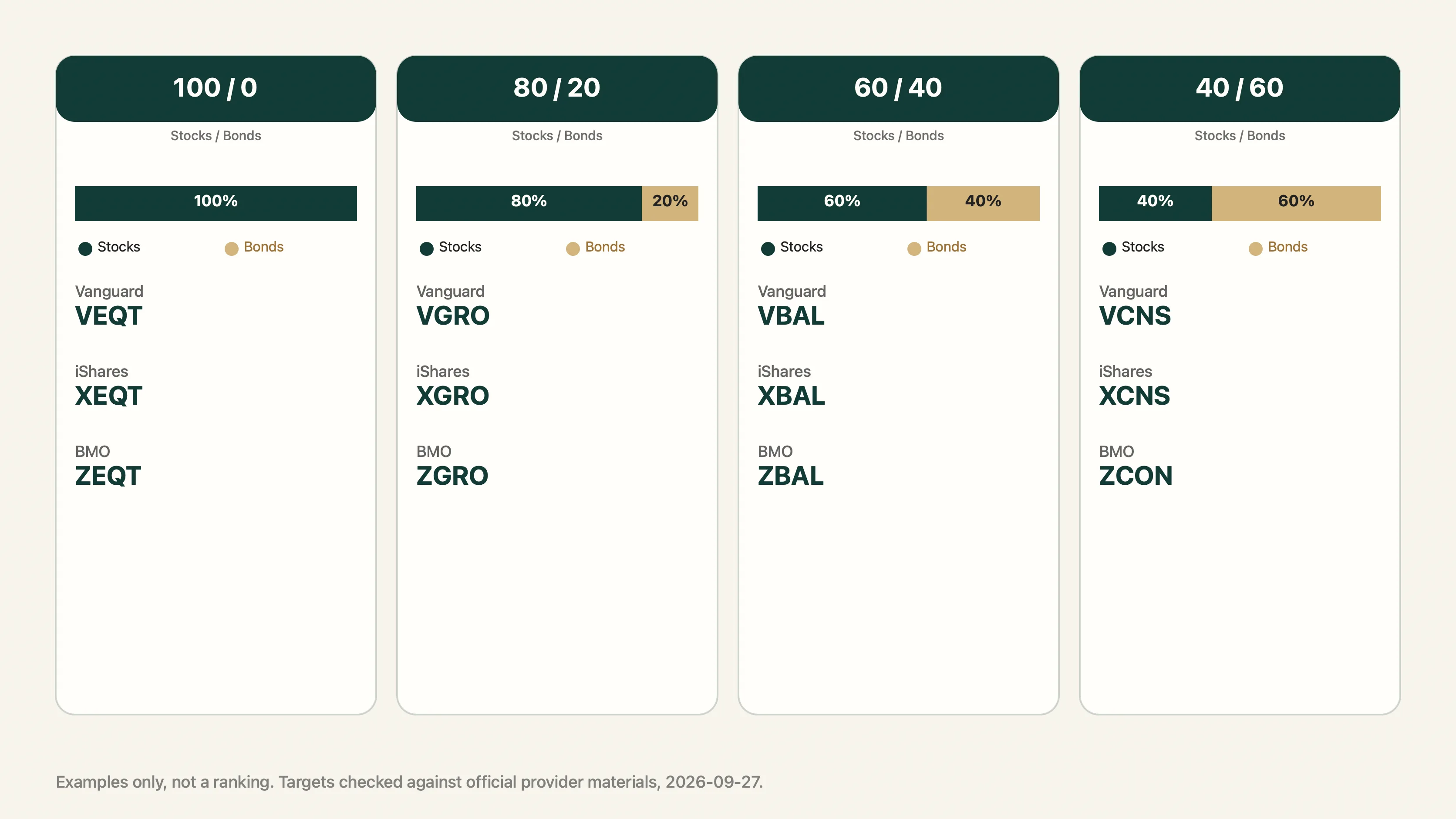 Four cards comparing stock-and-bond target mixes of 100/0, 80/20, 60/40, and 40/60, each shown as a stacked bar with matching Vanguard, iShares, and BMO ticker examples.
Figure 1. Four common target stock-and-bond mixes used by Vanguard, iShares, and BMO asset-allocation ETFs, checked 2026-09-27. This is not a ranking; the table below has the same information in accessible form.
| Target mix | Vanguard | iShares | BMO |
|---|---|---|---|
| 100% stocks / 0% bonds | VEQT | XEQT | ZEQT |
| 80% stocks / 20% bonds | VGRO | XGRO | ZGRO |
| 60% stocks / 40% bonds | VBAL | XBAL | ZBAL |
| 40% stocks / 60% bonds | VCNS | XCNS | ZCON |
The Canadian Couch Potato idea
The Canadian Couch Potato approach, popularized through the Canadian Couch Potato model portfolios, comes down to a few habits: diversify broadly instead of guessing at winners, keep costs low, choose an allocation you can actually hold through a downturn, contribute on a schedule, rebalance, and otherwise leave the portfolio alone. None of this promises a better return than an expert could get. It reduces the number of chances you have to make an emotional mistake.
The name sounds lazy, but the goal is not laziness. It is removing the decisions where beginners typically lose money: chasing last year's winning fund, trading on headlines, or skipping contributions when markets feel uncertain. An all-in-one asset-allocation ETF is a direct expression of this idea, since it bundles the diversification, the target mix, and the rebalancing into one product you buy on a schedule.
A five-question decision path
Work through these questions before choosing a mix, not after:
- What is my time horizon? Money you need soon behaves differently than money you will not touch for decades.
- How much loss can I actually afford? This is about your finances, not your feelings: what a decline would do to your plans.
- How much decline can I emotionally sit through without selling? A mix you abandon in a crash cannot do its job.
- Do I need any of this money in the near term? Near-term needs generally do not belong in a stock-heavy mix.
- Am I willing to stay invested through a real downturn? If the honest answer is no, a more conservative mix may fit better than a more aggressive one.
There is no single correct answer here. The point is to answer honestly before you buy, not after markets fall.
Before you buy
- Write down your time horizon and what this money is for.
- Answer the five questions above honestly, including the emotional one.
- Decide whether you want one all-in-one fund or your own building blocks.
- Verify every ticker, target mix, and fee on the provider's own official page on the day you act.
- Read the current fund facts before buying, including the holdings, risk rating, and costs.
Next step: Lesson 6 walks through actually placing your first ETF purchase.
Sources
- Vanguard Investments Canada, "Asset Allocation Investing overview": https://digital-assets.vanguard.com/intl/americas/canada/en/documents/Asset_Allocation_Investing_overview_EN.PDF
- BlackRock Canada, "Core ETF Portfolios product brief": https://www.blackrock.com/ca/investors/en/literature/product-brief/core-etf-portfolios-product-brief.pdf
- BMO Global Asset Management, "All-in-one Core ETFs: BMO Asset Allocation ETFs": https://thehub.bmosalessupport.com/system/files/all-in-one_core_etfs_bmo_asset_allocation_etfs_en.pdf
- Canadian Couch Potato, "Model Portfolios": https://canadiancouchpotato.com/model-portfolios/
- CIRO, "Why diversify your portfolio?": https://www.ciro.ca/office-investor/investing-basics/why-diversify-your-portfolio
- CIRO, "Types of investments and types of accounts": https://www.ciro.ca/office-investor/investing-basics/types-investments-and-types-accounts
- CIRO, "Fees and costs": https://www.ciro.ca/office-investor/investing-basics/fees-and-costs
- Ontario Securities Commission / GetSmarterAboutMoney, "What is risk tolerance in investing?": https://www.getsmarteraboutmoney.ca/learning-path/understanding-risk/what-is-risk-tolerance-in-investing/
Co-authored and managed by John Park and his team of AI agents, orchestrated by AXE.
Editorial gate
- Fact lock: the four target mixes (100/0, 80/20, 60/40, 40/60) and the twelve example tickers (VEQT, VGRO, VBAL, VCNS, XEQT, XGRO, XBAL, XCNS, ZEQT, ZGRO, ZBAL, ZCON) match the official Vanguard, BlackRock, and BMO asset-allocation materials checked 2026-09-27. No ETF is ranked or recommended, and no MER or fee figure is stated because none was directly reverified from each provider's current product page for this revision.
- Scope boundary: platform selection, fees and taxes, and compounding mechanics are covered in other lessons and are intentionally not repeated here.
- Chart build requirement: the comparison chart must be generated deterministically in code per the Yimuki Editorial Visual System. AI-generated raster images are not permitted for exact values, axes, or comparisons. The chart must remain legible at 320 CSS pixels wide and in dark mode, and must not encode meaning by colour alone.
- Mandatory recheck before publication: every ticker and target weight against the official Vanguard, BlackRock, and BMO asset-allocation materials, and the Canadian Couch Potato model portfolios page.
- Unresolved items: current MERs, trading details, and account-location tax treatment are intentionally outside this article and belong in separate fee- and tax-reviewed guides.
- Native-language review: required. English register and phrasing need review before publication.
- BLOCKED_PUBLICATION: this draft cannot be published. John's explicit approval of the exact revision, legal review, tax review, securities review, and investment-professional review are not yet complete.
Sources
- digital-assets.vanguard.comhttps://digital-assets.vanguard.com/intl/americas/canada/en/documents/Asset_Allocation_Investing_overview_EN.PDF
- blackrock.comhttps://www.blackrock.com/ca/investors/en/literature/product-brief/core-etf-portfolios-product-brief.pdf
- thehub.bmosalessupport.comhttps://thehub.bmosalessupport.com/system/files/all-in-one_core_etfs_bmo_asset_allocation_etfs_en.pdf
- canadiancouchpotato.comhttps://canadiancouchpotato.com/model-portfolios/
- ciro.cahttps://www.ciro.ca/office-investor/investing-basics/why-diversify-your-portfolio
- ciro.cahttps://www.ciro.ca/office-investor/investing-basics/types-investments-and-types-accounts
- ciro.cahttps://www.ciro.ca/office-investor/investing-basics/fees-and-costs
- getsmarteraboutmoney.cahttps://www.getsmarteraboutmoney.ca/learning-path/understanding-risk/what-is-risk-tolerance-in-investing/
Korean original
Read the Korean original at /articles/couch-potato-compounding-bonds-ko →