

Fees, Taxes, and Records: Stopping the Quiet Leaks
How MERs, commissions, spreads and currency conversion add up, which tax slips each account sends, and why you need to track adjusted cost base (ACB) yourself in a non-registered account.
- Published
- 2026-11-10
- Last verified
- 2026-11-10
- Recheck by
- 2027-01-20
- Reading time
- 11 min read
- Revision
- rev.1
- Editorial approval
- Approved 2026-11-10
Co-authored and managed by John Park and his team of AI agents, orchestrated by AXE.
TL;DR Investment costs are easy to miss because they leave a little at a time, every year. Check five: the fund's MER, commissions, the spread, currency conversion, and account or advice fees. In the hypothetical below, $10,000 held for 25 years ended $14,281 apart at an MER of 0.20% versus 2.00%. Taxes depend entirely on the account. A TFSA usually sends no annual slip; a non-registered account sends slips such as T5, T3 and T5008, and you track the adjusted cost base (ACB) yourself. This lesson is not tax advice.
If you followed Lesson 7, money is now being invested automatically every month. This lesson covers two things: spotting the costs that quietly leak from that money, and keeping records so tax season does not become a scramble. Build both habits early and they take only a few hours a year afterwards.
1. The five costs
| Cost | What it is | Where to find it |
|---|---|---|
| MER (management expense ratio) | A fund's yearly operating cost. Deducted from fund assets daily, never billed to you | ETF Facts, fund company page |
| Commission | What the platform charges per trade. Some charge zero | Fee schedule, trade confirmation |
| Spread | The gap between ask and bid (Lesson 6) | Bid and ask on the order screen |
| Currency conversion (FX) | A markup on the exchange rate when switching CAD and USD. Often not shown separately | Platform FX policy, compare the rate you got with the market rate |
| Account or advice fees | Robo-adviser management fees, adviser fees, account fees | Your agreement, the annual charges and compensation report |
ETF Facts documents show the MER alongside the trading expense ratio (TER), the cost of trading inside the fund. MER plus TER is closer to what holding the fund costs.
A small MER multiplied by time
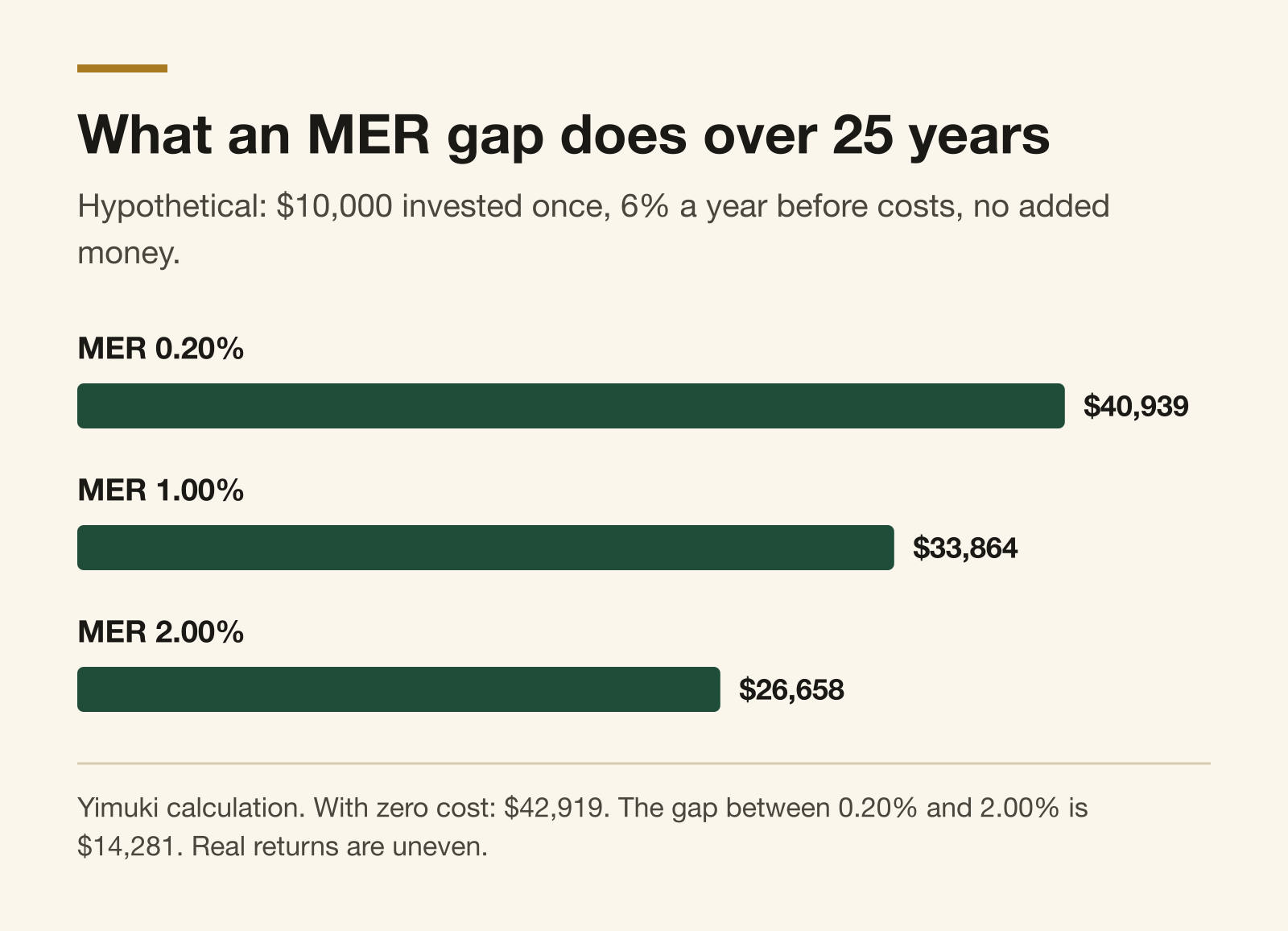 What an MER gap does over 25 years. Hypothetical: $10,000 invested once, 6% a year before costs, no added money.
Figure 1. Hypothetical value of $10,000 after 25 years at 6% a year before costs, by MER. Not a forecast.
Source: Yimuki calculation using compound growth Assumptions: $10,000 invested once, 6% a year before costs, net return = 6% minus MER, annual compounding, no tax or inflation Verified: 2026-10-22
| MER | Hypothetical value after 25 years | Gap versus zero cost ($42,919) |
|---|---|---|
| 0.20% | $40,939 | $1,980 |
| 1.00% | $33,864 | $9,055 |
| 2.00% | $26,658 | $16,261 |
Lower cost does not automatically mean a better product. If advice keeps you from costly behavioural mistakes, it can be worth paying for. What matters is knowing what you pay, and for what.
2. Currency conversion: an easy cost to miss
Many Korean newcomers already know US stocks from investing back home, and look for US-listed ETFs or shares right away in Canada too. Buying US-dollar assets means converting CAD to USD, and platforms often add a percentage to the market rate. That cost may never show up as a line item.
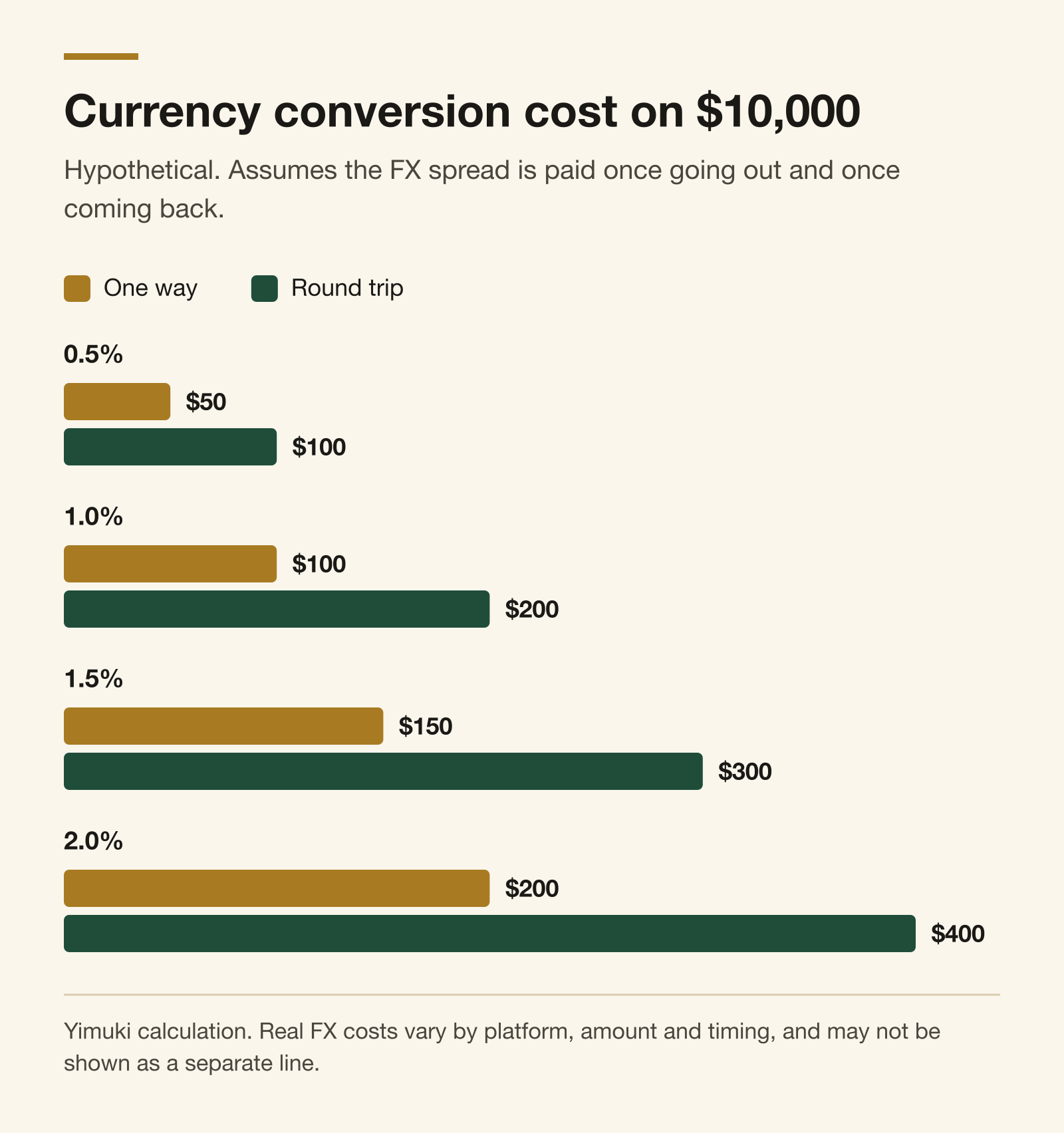 Currency conversion cost on $10,000. Hypothetical. Assumes the FX spread is paid once going out and once coming back.
Figure 2. Hypothetical cost of converting $10,000 at different FX spreads, paid once going out and once coming back.
- The Canadian-listed asset allocation ETFs from Lesson 5 trade in CAD, so you do not convert anything yourself. The cost of holding foreign assets inside the fund shows up in its MER, TER and foreign withholding tax.
- If you do want US-dollar assets, first check whether your platform has a USD account, whether conversions happen automatically, and what rate you actually get.
- Some investors reduce conversion costs by using a security listed in both CAD and USD (commonly called "Norbert's Gambit"). The steps are fiddly and availability varies by platform. If you do not fully understand it, skip it.
3. Taxes by account: which slips arrive
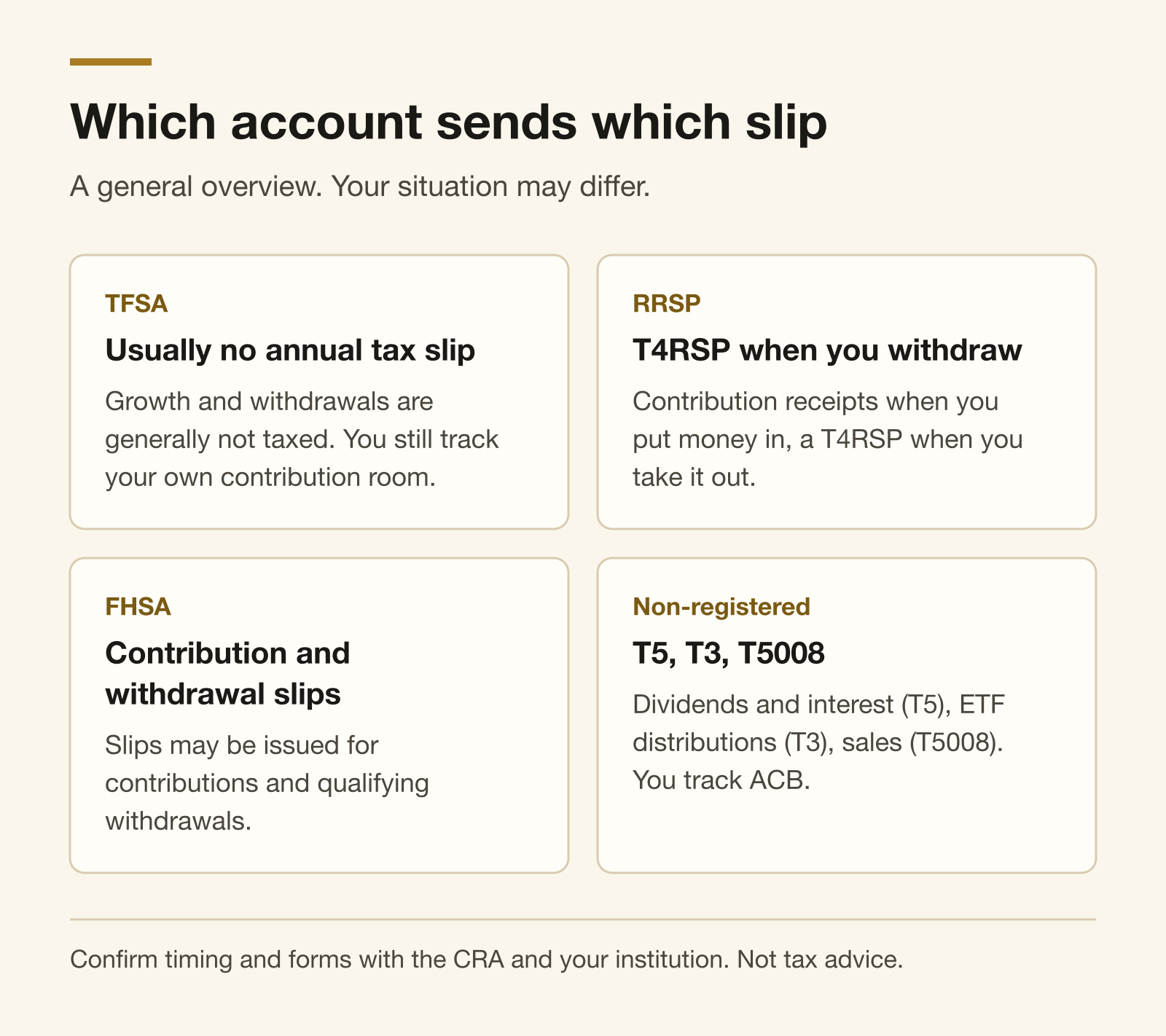 Which account sends which slip. A general overview. Your situation may differ.
Figure 3. Typical tax slips by account type. A general overview; your situation may differ.
| Slip | What it reports | Usually from |
|---|---|---|
| T5 | Investment income such as dividends and interest | Non-registered |
| T3 | Distributions from ETFs and funds, broken out by income type | Non-registered |
| T5008 | Sales of securities | Non-registered |
| RRSP contribution receipt | RRSP contributions (for your deduction) | RRSP |
| T4RSP | RRSP withdrawals | RRSP |
| T1135 | A form you file yourself if the cost of specified foreign property tops $100,000 at any time in the year | When it applies |
Four things to know about non-registered accounts
- Only half of a capital gain is included in income. This is the inclusion rate. Budget 2024 proposed raising it to two-thirds for some gains, but the government cancelled that increase on March 21, 2025. As checked on November 10, 2026, the general inclusion rate for individuals is one-half.
- You track your ACB. If you bought the same ETF several times, your cost is averaged, and reinvested distributions and some distribution types (such as return of capital) change ACB. A T5008 may show a blank or wrong cost, so check platform figures against your own records.
- The superficial loss rule. If you sell at a loss and you or an affiliated person, such as a spouse, buys and still holds the same security within 30 days before or after the sale, the loss may be denied for that year.
- Foreign property reporting (T1135). If the total cost of specified foreign property, such as US-listed ETFs or US shares, exceeds $100,000 at any point in the year, you must report it. Canadian-listed ETFs are generally excluded from this count even when they hold foreign stocks, and assets inside registered accounts are excluded too.
Foreign dividends and withholding tax
Dividends from US companies usually have US withholding tax taken off. Under the Canada-US tax treaty it is generally 15%, and if you hold US-listed securities directly, your platform needs a W-8BEN form on file for the treaty rate to apply. Whether you can recover that tax depends on the account.
- Non-registered: you can generally claim a foreign tax credit.
- RRSP: US-listed securities held directly are often exempt from withholding under the treaty.
- TFSA, FHSA: withheld tax generally cannot be recovered.
These differences are the subject of asset location, deciding which assets go in which account. At the beginner stage, keeping accounts and portfolios simple usually matters more than optimizing this. As balances grow, talk to a tax professional.
4. Records: what to keep, and for how long
The CRA generally asks you to keep records for six years from the end of the tax year they relate to. Investment records may need to last longer, because a non-registered ACB runs from your first purchase to your last sale.
Keep:
- Trade confirmations for every buy and sell (Lesson 6)
- Monthly or quarterly account statements
- The annual report on charges and other compensation, which registered firms send each year to show what you paid them. Under new rules effective January 1, 2026, reports covering 2026 onward also show fund expenses (MER plus TER) in dollars and as a percentage; investors start receiving them in early 2027.
- Tax slips and RRSP and FHSA receipts
- An ACB log: by product, the date, units, total cost, distribution adjustments and sales
A simple spreadsheet with one row per transaction is enough. Some free web tools help calculate ACB, but you should keep the original transaction records yourself.
The strongest counterargument
"Most beginners only use a TFSA and RRSP, so they don't need to know about ACB or T1135." Largely true. If you only buy and sell Canadian-listed ETFs inside registered accounts, there are few slips to track each year and often no ACB to calculate. That simplicity is a real advantage for beginners.
But the day you fill your registered room and open a non-registered account, get curious about US stocks, or move assets from Korea to Canada tends to arrive sooner than expected. If there are no records by then, you will be reconstructing years of trades backwards. Keeping records now is insurance that costs almost nothing. Reporting obligations for assets and income held in Korea or elsewhere are beyond this lesson; if they apply to you, speak with a tax professional.
Fees, taxes and records checklist
- I checked the MER and TER of my ETFs in their ETF Facts
- I checked my platform's commissions and FX policy
- I know when automatic currency conversion happens
- If I hold US-listed securities directly, I checked that a W-8BEN is on file
- I know which tax slips each of my accounts will send
- If I have a non-registered account, I started an ACB log for each product
- I know the 30-day rule for selling at a loss
- I will check T1135 if my foreign property cost approaches $100,000
- I keep trade confirmations, statements, annual cost reports and T-slips in one folder
Next: Lesson 9 prepares for the moment that tests a plan hardest: markets falling 20%, 30% or 50%.
Sources
- CIRO, "Fees and costs": https://www.ciro.ca/office-investor/investing-basics/fees-and-costs
- Ontario Securities Commission / GetSmarterAboutMoney, "How Exchange-Traded Funds (ETFs) work": https://www.getsmarteraboutmoney.ca/learning-path/etfs/how-exchange-traded-funds-etfs-work/
- Canada Revenue Agency, "Calculating and reporting your capital gains and losses": https://www.canada.ca/en/revenue-agency/services/tax/individuals/topics/about-your-tax-return/tax-return/completing-a-tax-return/personal-income/line-12700-capital-gains/calculating-reporting-your-capital-gains-losses.html
- Canada Revenue Agency, "Capital losses" (superficial loss): https://www.canada.ca/en/revenue-agency/services/tax/individuals/topics/about-your-tax-return/tax-return/completing-a-tax-return/personal-income/line-12700-capital-gains/capital-losses-deductions.html#SL
- Canada Revenue Agency, "Questions and answers about Form T1135": https://www.canada.ca/en/revenue-agency/services/tax/international-non-residents/information-been-moved/foreign-reporting/questions-answers-about-form-t1135.html
- Canada Revenue Agency, "How long should you keep your income tax records?": https://www.canada.ca/en/revenue-agency/services/tax/individuals/topics/about-your-tax-return/long-should-you-keep-your-income-tax-records.html
- Prime Minister of Canada, "Prime Minister Mark Carney cancels proposed capital gains tax increase" (2025-03-21): https://www.pm.gc.ca/en/news/news-releases/2025/03/21/prime-minister-mark-carney-cancels-proposed-capital-gains-tax-increase
- Vanguard Investments Canada, "The impact of withholding taxes on Canadian ETF investors" (PDF): https://www.vanguard.ca/content/dam/intl/americas/canada/en/documents/INAEE_CA_062025_WithholdingTax_Guide.pdf
- Department of Finance Canada, "Canada-United States Convention with Respect to Taxes on Income and on Capital" (Articles X and XXI): https://www.canada.ca/en/department-finance/programs/tax-policy/tax-treaties/country/united-states-america-convention-consolidated-1980-1983-1984-1995-1997-2007.html
- CIRO, "Total Cost Reporting: What Investors Need to Know for 2027": https://www.ciro.ca/office-investor/investing-basics/total-cost-reporting-what-investors-need-know-2027
Disclaimer: This content is provided for general informational and educational purposes only. It is not investment, financial, tax, or legal advice. Yimuki Markets is not a registered investment adviser. All investing involves risk, including possible loss of principal. Consider your circumstances and consult a qualified professional before making financial decisions.
Publication gate
BLOCKED_PUBLICATION: Requires John's exact-revision approval plus Canadian legal, tax, investment, and Korean-language review. All dated claims must be rechecked within seven days of publication.
Co-authored and managed by John Park and his team of AI agents, orchestrated by AXE.
Sources
- ciro.cahttps://www.ciro.ca/office-investor/investing-basics/fees-and-costs
- getsmarteraboutmoney.cahttps://www.getsmarteraboutmoney.ca/learning-path/etfs/how-exchange-traded-funds-etfs-work/
- canada.cahttps://www.canada.ca/en/revenue-agency/services/tax/individuals/topics/about-your-tax-return/tax-return/completing-a-tax-return/personal-income/line-12700-capital-gains/calculating-reporting-your-capital-gains-losses.html
- canada.cahttps://www.canada.ca/en/revenue-agency/services/tax/individuals/topics/about-your-tax-return/tax-return/completing-a-tax-return/personal-income/line-12700-capital-gains/capital-losses-deductions.html#SL
- canada.cahttps://www.canada.ca/en/revenue-agency/services/tax/international-non-residents/information-been-moved/foreign-reporting/questions-answers-about-form-t1135.html
- canada.cahttps://www.canada.ca/en/revenue-agency/services/tax/individuals/topics/about-your-tax-return/long-should-you-keep-your-income-tax-records.html
- pm.gc.cahttps://www.pm.gc.ca/en/news/news-releases/2025/03/21/prime-minister-mark-carney-cancels-proposed-capital-gains-tax-increase
- vanguard.cahttps://www.vanguard.ca/content/dam/intl/americas/canada/en/documents/INAEE_CA_062025_WithholdingTax_Guide.pdf
- canada.cahttps://www.canada.ca/en/department-finance/programs/tax-policy/tax-treaties/country/united-states-america-convention-consolidated-1980-1983-1984-1995-1997-2007.html
- ciro.cahttps://www.ciro.ca/office-investor/investing-basics/total-cost-reporting-what-investors-need-know-2027
Korean original
Read the Korean original at /articles/fees-taxes-records-canada-ko →