

Automate Contributions and DCA: Decide Once, Then Let It Run
Turn one purchase into a monthly habit. Pick an amount you can sustain, set up automatic transfers and purchases, and write down in advance when it is fine to pause and when it is not.
- Published
- 2026-11-10
- Last verified
- 2026-11-10
- Recheck by
- 2027-01-20
- Reading time
- 8 min read
- Revision
- rev.1
- Editorial approval
- Approved 2026-11-10
Co-authored and managed by John Park and his team of AI agents, orchestrated by AXE.
TL;DR Lesson 2 explained what dollar-cost averaging (DCA) is. This lesson makes it actually run. Three things matter: choose an amount you can keep paying in a bad month, have money move automatically right after payday, and make sure the purchase itself happens on a set day. Once a year, decide whether to raise the amount. In the calculation below, raising $200 a month by 3% a year ended about $42,000 ahead of a flat $200 after 25 years, but much of that came from putting more in. This is arithmetic, not a forecast.
If you made a purchase in Lesson 6, the hardest part is behind you. The next challenge is continuing. As Lesson 2 showed, behaviour often harms results more than lack of knowledge. A plan that asks "should I buy this month?" every month is easy to abandon in a frightening month. Automation removes the question.
1. Start with the amount: plan for the hard month, not the good one
Set the automatic amount by asking "Could I keep paying this in a month when income drops?" rather than "How much would I like to invest?" This matters most if you are new to Canada with uneven income, self-employed, on shift work or in seasonal work.
- Keep the emergency fund from Lesson 1 separate. If your investment plan doubles as your emergency fund, a sudden expense can force you to sell during a downturn.
- If income is irregular, a small base amount plus extra contributions in good months is easier to sustain. John's approach in Lesson 2 worked the same way: the base never stopped, only the extra changed.
- Starting small is fine. You can raise the amount later; restarting after abandoning an over-ambitious plan is harder.
2. How automation flows
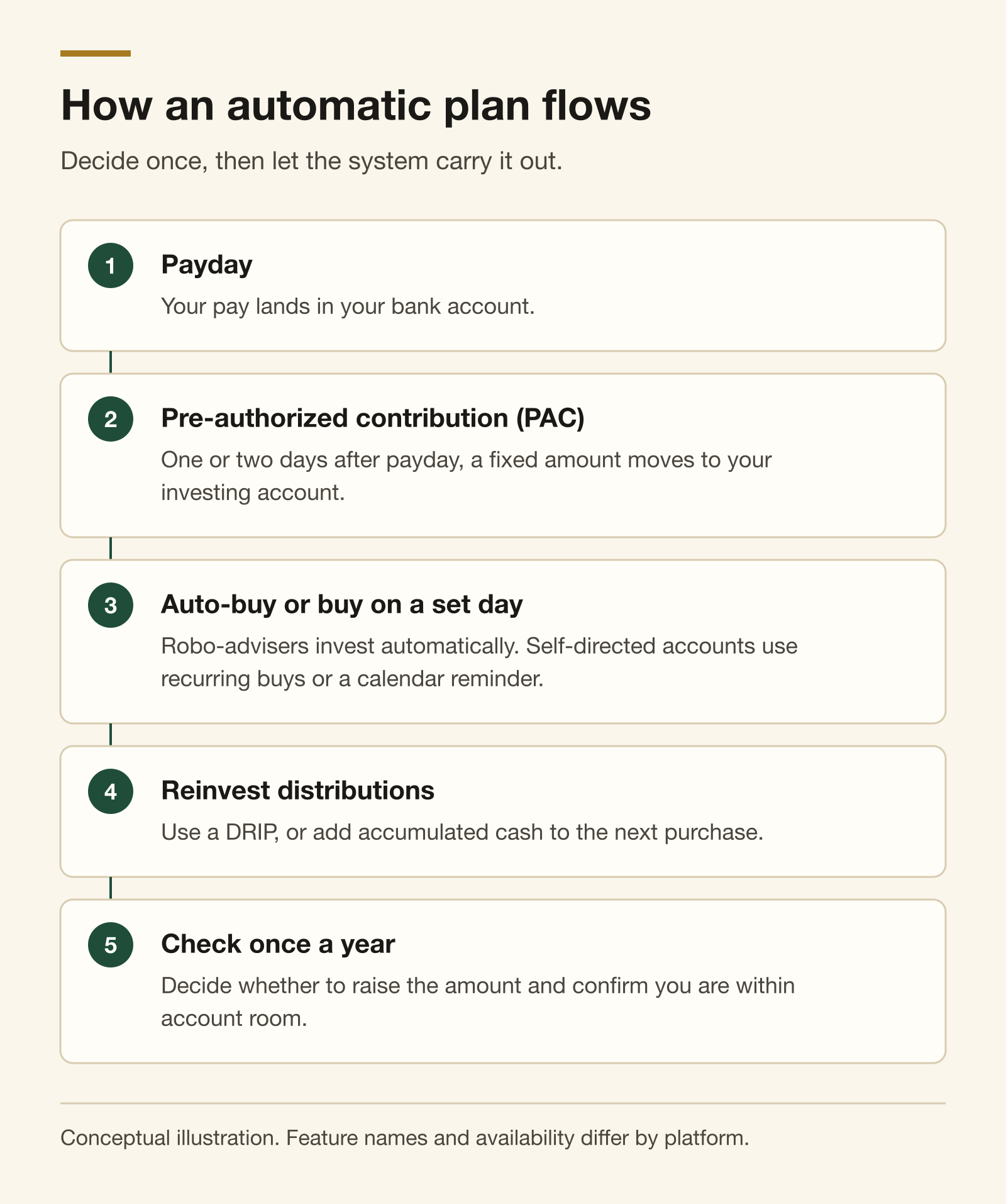 How an automatic plan flows. Decide once, then let the system carry it out.
Figure 1. How an automatic plan flows. Feature names and availability differ by platform.
A pre-authorized contribution (PAC) moves a fixed amount from your bank to your investing account on a set date. Most Canadian platforms offer it. Scheduling it one or two business days after payday reduces the chance of a transfer being attempted before your pay arrives.
Moving money and actually buying are separate steps. Miss this and you can end up with cash quietly piling up in the account.
| Platform type | How the purchase happens | What to check |
|---|---|---|
| Robo-adviser | Transferred money is invested automatically in your portfolio | Management fee, portfolio makeup |
| Self-directed platform with recurring buys | A chosen ETF is bought automatically on a set date | Eligible products, fractional shares, commissions |
| Self-directed platform without recurring buys | You buy on a set date yourself (Lesson 6 steps) | Calendar reminder, same routine every time |
If you buy manually, fix the date and the process: "On the morning of day X each month, I buy using the Lesson 6 checklist." You already decided what to buy in Lesson 5, so that day's job is execution, not judgement.
What about distributions?
ETFs may pay distributions (dividends or interest). Automatically reinvesting them into the same ETF is called a DRIP. If your platform does not offer one, distributions build up as cash; simply include it in your next scheduled purchase. In a non-registered account, reinvested distributions affect your adjusted cost base (ACB), which is why Lesson 8's record keeping matters.
3. Raise the amount once a year
The hidden risk of automation is an amount that stays the same for years. If your income grows but contributions do not, the plan shrinks in relative terms. Review the amount once a year, for example at a raise or in January.
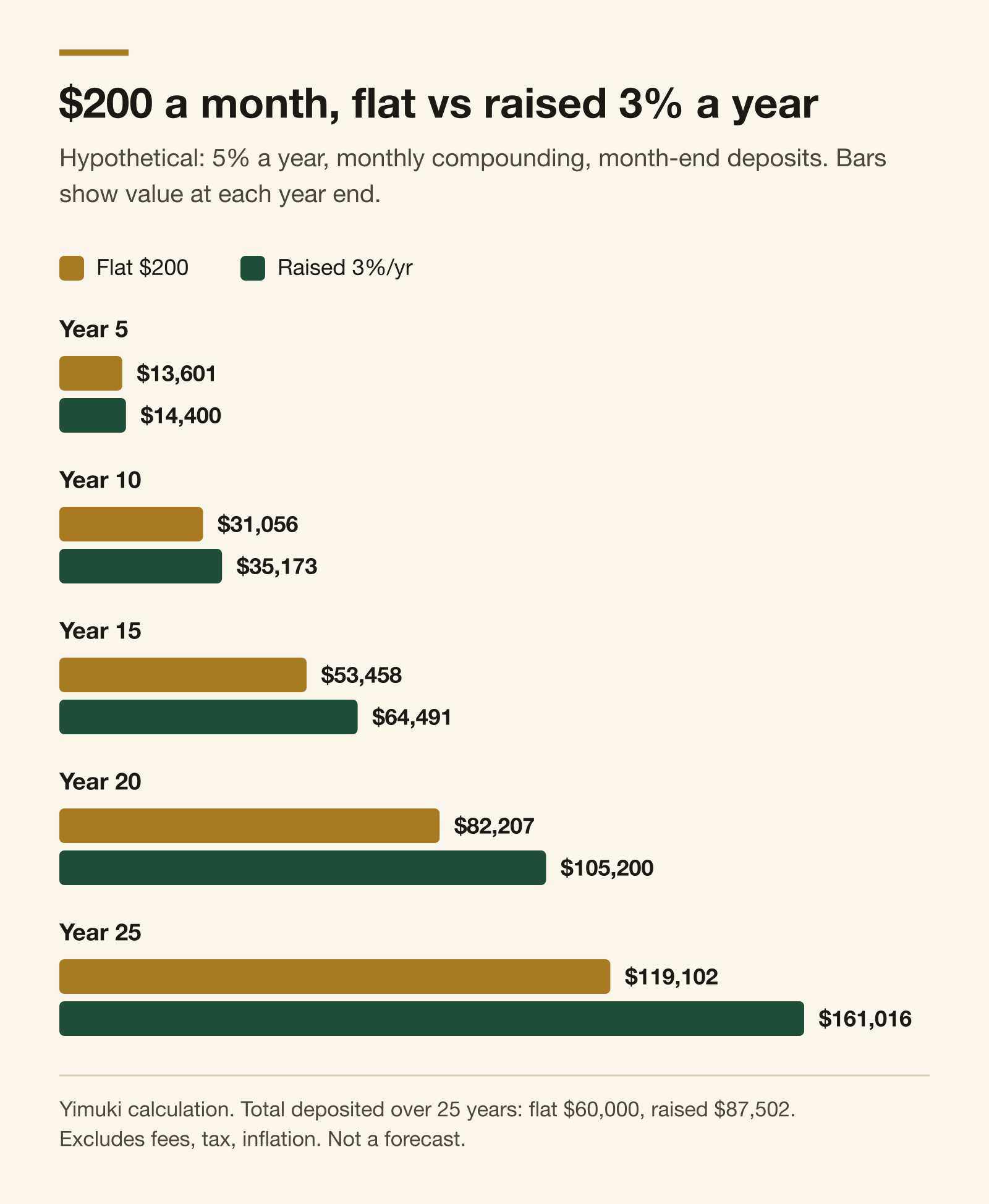 $200 a month, flat vs raised 3% a year. Hypothetical: 5% a year, monthly compounding, month-end deposits. Bars show value at each year end.
Figure 2. Hypothetical value of $200 a month flat versus raised 3% each year. 5% a year, monthly compounding, before fees, tax and inflation. Not a forecast.
Source: Yimuki calculation using the future value of month-end deposits Assumptions: 5% nominal annual return, monthly compounding, deposit raised 3% at the start of each year, no fees, tax or inflation Verified: 2026-10-22
| Year | Flat $200, hypothetical value | Raised 3%/yr, hypothetical value | Raised: total deposited |
|---|---|---|---|
| 5 | $13,601 | $14,400 | $12,742 |
| 10 | $31,056 | $35,173 | $27,513 |
| 15 | $53,458 | $64,491 | $44,637 |
| 20 | $82,207 | $105,200 | $64,489 |
| 25 | $119,102 | $161,016 | $87,502 |
Read this honestly. Much of the roughly $42,000 gap after 25 years exists because more money went in ($27,502 more in deposits). The step-up is not magic; it is the result of steadily moving part of a rising income into the plan. Real returns vary year to year and can be negative.
4. Watch contribution room and account order
Automation is convenient, but it may not stop on its own when you hit a limit.
- TFSA: Excess contributions are taxed at 1% per month for as long as the excess remains. A common confusion: money you withdraw is added back to your room on January 1 of the following year, not the same year.
- RRSP and FHSA: Each has its own limit rules. Check CRA My Account alongside your own records.
- If you split money across accounts, write down how much goes where. If the priorities you set in Lesson 3 change, change the automatic transfers too.
Exact limits and rules can change from year to year, so confirm them on the CRA's official pages.
5. When pausing makes sense, and when it does not
Writing down the conditions for pausing when you build the plan keeps emotion from making the call later.
| Situation | General approach |
|---|---|
| Job loss, a large income drop, emergency fund running low | Pausing or reducing can be reasonable. Refill the emergency fund first. |
| New high-interest debt | Go back to the Lesson 1 order and consider paying it down first. |
| A near-term goal such as a home purchase | That money now has a shorter time horizon; review the account and mix. |
| Scary news, a falling market | Usually not a reason to change the plan. Lesson 9 covers this in depth. |
| The market looks expensive after a big run | Keep the base contribution. If you adjust anything, adjust only the extra. |
The strongest counterargument
"If you already have a lump sum, investing it all at once has historically come out ahead more often than spreading it out." This rests on real evidence. Markets have risen in more periods than they have fallen, so drip-feeding money you already have leaves part of it on the sidelines. FINRA also notes that DCA often returns less than investing a lump sum. And DCA neither guarantees a profit nor protects against losses in a falling market.
That argument, though, is about money you already have. Most beginners invest from each paycheque, so regular contributions are not really a choice; they are simply the pace at which money becomes available. And if investing a lump sum at once would leave you likely to quit after an early drop, spreading it out, even at a somewhat lower expected return, may be the plan you can actually stick with. As Lesson 2 noted, just choose it knowing it involves some market timing.
Automatic plan checklist
- I chose a base amount I can pay even in a bad month
- My emergency fund is separate from my investing account
- I set a PAC one or two business days after payday
- I decided how transferred cash is actually invested (auto-invest, recurring buy, or a fixed manual buy date)
- I decided how distributions are handled (DRIP or included in the next purchase)
- I wrote down contribution room and the yearly plan for each account
- I put a review date (for example, every January) in my calendar
- I wrote down when I will pause, and when I will not
Next: Lesson 8 covers the costs that quietly leak from a growing portfolio, and the records you need at tax time.
Sources
- Canada Revenue Agency, "Tax-Free Savings Account (TFSA)": https://www.canada.ca/en/revenue-agency/services/tax/individuals/topics/tax-free-savings-account.html
- Canada Revenue Agency, "If you owe tax on excess TFSA amounts": https://www.canada.ca/en/revenue-agency/services/tax/individuals/topics/tax-free-savings-account/owing-tax/excess.html
- Canada Revenue Agency, "Withdrawing from a TFSA": https://www.canada.ca/en/revenue-agency/services/tax/individuals/topics/tax-free-savings-account/withdraw.html
- Canada Revenue Agency, "First Home Savings Account (FHSA)": https://www.canada.ca/en/revenue-agency/services/tax/individuals/topics/first-home-savings-account.html
- Financial Consumer Agency of Canada, "Setting savings and investment goals": https://www.canada.ca/en/financial-consumer-agency/services/savings-investments/savings-investment-goals.html
- FINRA, "Dollar-Cost Averaging": https://www.finra.org/investors/insights/dollar-cost-averaging
- U.S. Securities and Exchange Commission, Investor.gov, "Dollar cost averaging": https://www.investor.gov/introduction-investing/investing-basics/glossary/dollar-cost-averaging
- Ontario Securities Commission / GetSmarterAboutMoney, "Tips for first-time investors": https://www.getsmarteraboutmoney.ca/learning-path/getting-started/tips-for-first-time-investors/
Disclaimer: This content is provided for general informational and educational purposes only. It is not investment, financial, tax, or legal advice. Yimuki Markets is not a registered investment adviser. All investing involves risk, including possible loss of principal. Consider your circumstances and consult a qualified professional before making financial decisions.
Publication gate
BLOCKED_PUBLICATION: Requires John's exact-revision approval plus Canadian legal, tax, investment, and Korean-language review. All dated claims must be rechecked within seven days of publication.
Co-authored and managed by John Park and his team of AI agents, orchestrated by AXE.
Sources
- canada.cahttps://www.canada.ca/en/revenue-agency/services/tax/individuals/topics/tax-free-savings-account.html
- canada.cahttps://www.canada.ca/en/revenue-agency/services/tax/individuals/topics/tax-free-savings-account/owing-tax/excess.html
- canada.cahttps://www.canada.ca/en/revenue-agency/services/tax/individuals/topics/tax-free-savings-account/withdraw.html
- canada.cahttps://www.canada.ca/en/revenue-agency/services/tax/individuals/topics/first-home-savings-account.html
- canada.cahttps://www.canada.ca/en/financial-consumer-agency/services/savings-investments/savings-investment-goals.html
- finra.orghttps://www.finra.org/investors/insights/dollar-cost-averaging
- investor.govhttps://www.investor.gov/introduction-investing/investing-basics/glossary/dollar-cost-averaging
- getsmarteraboutmoney.cahttps://www.getsmarteraboutmoney.ca/learning-path/getting-started/tips-for-first-time-investors/
Korean original
Read the Korean original at /articles/automate-contributions-dca-plan-ko →