

Scam Checks and Your Annual Review: Protecting What You Built
The final lesson. How to check registration and investor protection, the fraud signals that show up most often in Korean communities, rebalancing, and a once-a-year checklist to close the ten-step course.
- Published
- 2026-11-10
- Last verified
- 2026-11-10
- Recheck by
- 2027-01-20
- Reading time
- 10 min read
- Revision
- rev.1
- Editorial approval
- Approved 2026-11-10
Co-authored and managed by John Park and his team of AI agents, orchestrated by AXE.
TL;DR Markets can recover from a downturn, but money lost to fraud rarely comes back. Before you hand over money or act on an investment pitch, check two things: whether the person or firm is registered with securities regulators (aretheyregistered.ca), and whether the firm holding your account is a CIPF member. Guaranteed returns, pressure to hurry, group-chat invitations and requests to pay by crypto or gift card are classic fraud signals. Finally, a once-a-year review of allocation, costs, contribution room, registration and goals keeps the plan you built working for the long run.
From Lesson 1 to Lesson 9 you chose accounts and a platform, bought a portfolio, automated it, and prepared for costs and downturns. This last lesson is about protecting all of that from outside threats and realigning it once a year. Neither is complicated, but skipping them can undo the previous nine steps at once.
1. Check registration: one minute before you hand over money
In Canada, people and firms that sell securities or give investment advice generally must be registered with the securities regulator in their province or territory. Checking takes about a minute.
| What to check | Where | What to look for |
|---|---|---|
| Whether a person or firm is registered | CSA National Registration Search (aretheyregistered.ca) | Name, firm, registration category, provinces, any terms and conditions |
| An adviser's background and discipline history | CIRO AdvisorReport | Career history, disciplinary records |
| Investor protection at the firm holding your account | CIPF member directory (cipf.ca) | Membership |
| Whether regulators have issued a warning | CSA investor alerts, provincial commissions (BCSC, OSC and others) | Impersonators, unregistered firms |
- Registration does not mean an investment is good. It means the person or firm is qualified and supervised. If they are not registered, stopping there is the safe choice.
- Fraudsters often impersonate real registered people and firms. Contact them yourself using the official details from the search result, never a phone number or link the caller gave you.
CIPF and CDIC are different
CIPF protects clients when a member dealer becomes insolvent and client assets go missing, generally up to $1 million per account category. General accounts (TFSA, cash accounts and others), retirement accounts (RRSP, RRIF and others) and education accounts (RESP) are separate categories. CDIC protects eligible deposits such as bank deposits and some GICs, up to $100,000 per category.
Neither one covers losses from falling markets or from investing in a fraudulent product. Knowing what protection does and does not cover is part of avoiding fraud.
2. Eight signs of investment fraud
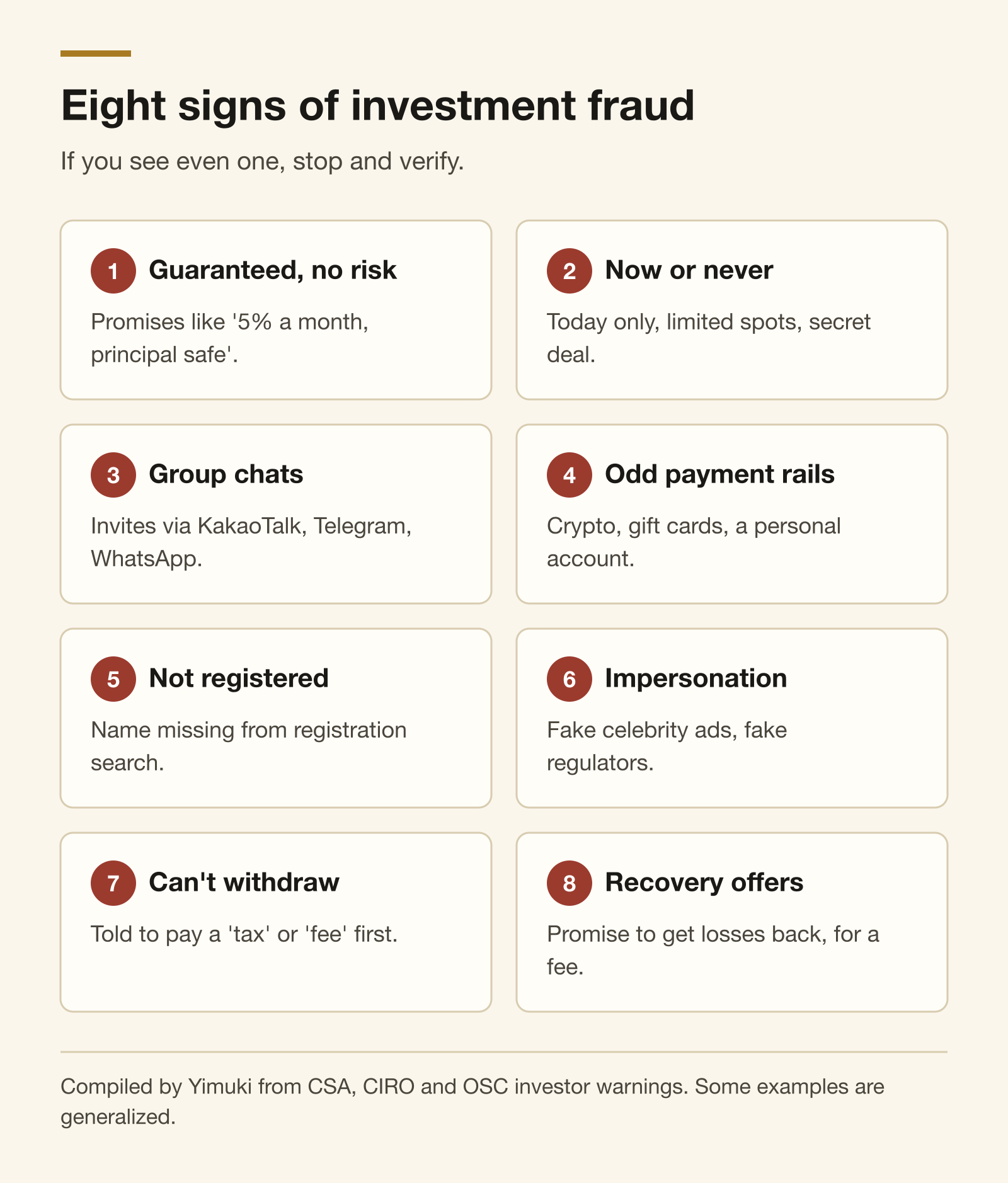 Eight signs of investment fraud. If you see even one, stop and verify.
Figure 1. Eight signs of investment fraud. Generalized examples compiled from CSA, CIRO and OSC investor warnings.
Figure 1 shows these eight signals, in this order. If you see even one, stop and verify.
- Guaranteed, no risk. Promises like '5% a month, principal safe'.
- Now or never. Today only, limited spots, secret deal.
- Group chats. Invites via KakaoTalk, Telegram, WhatsApp.
- Odd payment rails. Crypto, gift cards, a personal account.
- Not registered. Name missing from registration search.
- Impersonation. Fake celebrity ads, fake regulators.
- Can't withdraw. Told to pay a 'tax' or 'fee' first.
- Recovery offers. Promise to get losses back, for a fee.
Forms that show up often in Korean communities
- "Leading rooms" and group chats. An "expert" in a KakaoTalk, Telegram or WhatsApp group picks stocks, shows small early wins, then asks you to move to a special app or an overseas exchange.
- Same language, same church, same hometown. Fraud spreads easily along lines of trust within a community; this is called affinity fraud. "One of us" is never a substitute for a registration check.
- Fake celebrity ads. Social media ads impersonate well-known Korean or Canadian investors, entertainers and news outlets, increasingly with AI-generated video and voice.
- Romance or friendship that turns into an investment pitch. Someone met online raises crypto investing after weeks or months.
- "Pay a tax or fee first to withdraw." The profit on screen is just a number; this step exists to get more money from you.
- "Recovery" offers. Victims are contacted again with offers to get lost money back, for a fee. This is often a second scam.
If you suspect fraud, or have been a victim
- Stop sending money. "Just pay a little more and the withdrawal will go through" is almost always false.
- Save the chat history, transfer records, website addresses, names and contact details.
- Contact your bank or platform right away.
- Report to the Canadian Anti-Fraud Centre (1-888-495-8501) and your provincial securities commission (the BCSC in British Columbia, the OSC in Ontario). You can also report to local police.
- Do not be ashamed. Fraud is designed to catch smart people. Reporting it protects the next victim.
3. Rebalancing: back to target once a year
Over time, whatever performed well grows as a share of your portfolio, and your planned risk level quietly changes. Rebalancing brings it back to your target.
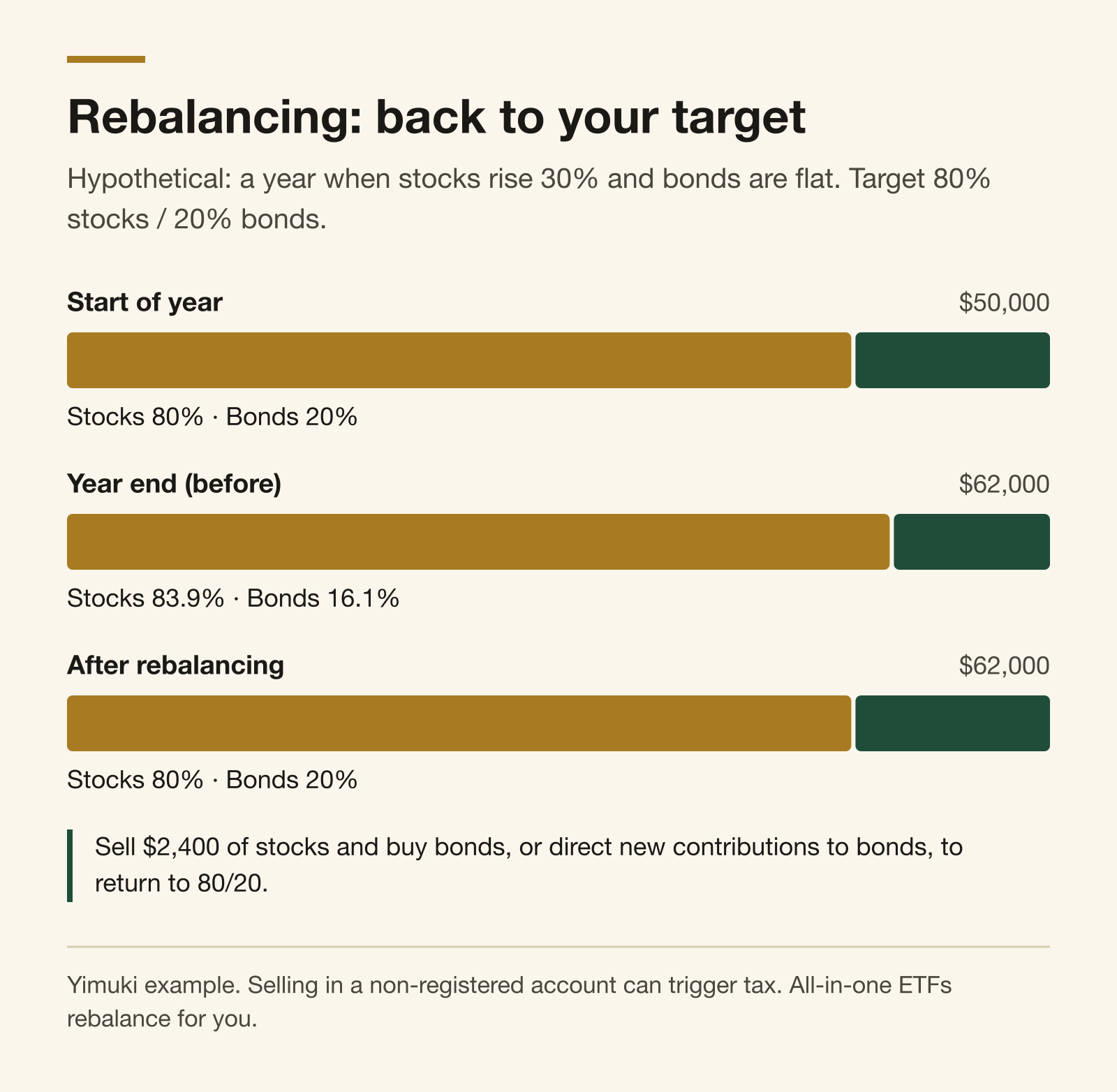 Rebalancing: back to your target. Hypothetical: a year when stocks rise 30% and bonds are flat. Target 80% stocks / 20% bonds.
Figure 2. Hypothetical rebalancing after a year when stocks rose 30%. Target: 80% stocks / 20% bonds.
Source: Yimuki arithmetic example Assumptions: $50,000 at the start ($40,000 stocks, $10,000 bonds), stocks +30%, bonds 0%, no contributions, distributions, fees or tax Verified: 2026-10-22
| Point in time | Stocks | Bonds | Total | Stock weight |
|---|---|---|---|---|
| Start of year | $40,000 | $10,000 | $50,000 | 80% |
| Year end (before) | $52,000 | $10,000 | $62,000 | 83.9% |
| After rebalancing | $49,600 | $12,400 | $62,000 | 80% |
There are three main ways to rebalance.
- With contributions: send new money to whatever is underweight. Nothing is sold, so there is no tax even in a non-registered account. Consider this first.
- By calendar: rebalance to target on a set date once a year.
- By threshold: rebalance only when an asset drifts beyond a set band (for example, 5 percentage points).
If you use an all-in-one asset allocation ETF from Lesson 5, the fund company rebalances inside the fund, so you usually do nothing. If you combined several ETFs yourself, pick one method and write it into your plan.
4. The annual review: once a year, about two hours
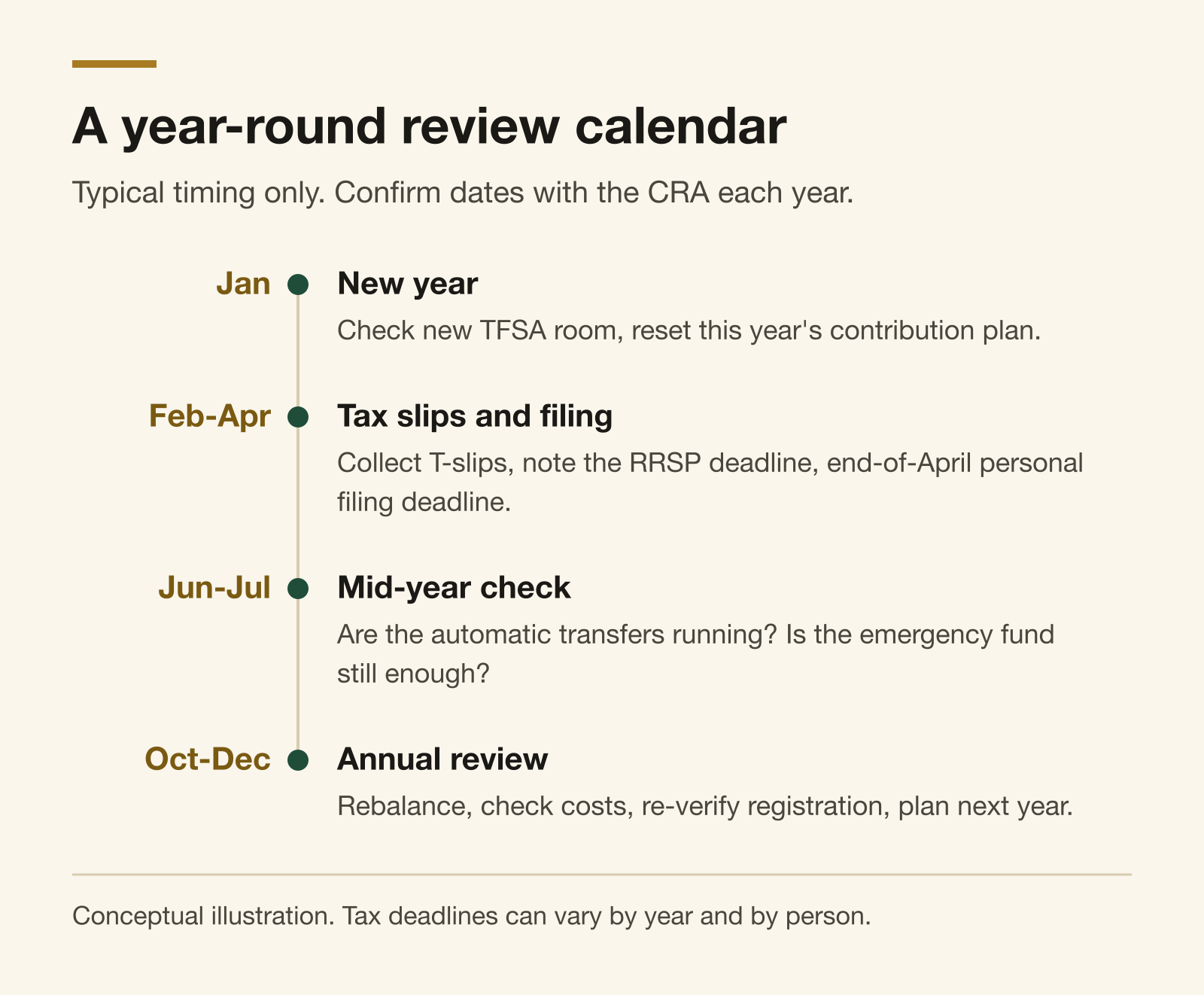 A year-round review calendar. Typical timing only. Confirm dates with the CRA each year.
Figure 3. A year-round review calendar. Typical timing only; confirm dates with the CRA each year.
Run this checklist once a year on the same date, for example at year end or right after filing your taxes. Write a few lines about the result; it becomes next year's starting point.
| Area | Review question | Related lesson |
|---|---|---|
| Foundations | Is my emergency fund still enough? Any new high-interest debt? | 1 |
| Goals | Has the purpose or timing of this money changed? | 1, 5 |
| Accounts | Did I check this year's room? Has my account priority changed? | 3 |
| Platform | Have fees or services changed? Is it still a CIPF member? | 4, 10 |
| Allocation | How far am I from target? Do I need to rebalance? | 5, 10 |
| Contributions | Are automatic transfers still running? Can I raise the amount? | 7 |
| Costs | Did I check MERs, trading and FX costs, and the annual cost report? | 8 |
| Records | Are confirmations, statements, T-slips and ACB records organized? | 8 |
| Downturns | Did I re-read my downturn plan? Does it still fit me? | 9 |
| Safety | Did I re-check my adviser's or firm's registration? Any suspicious contact? | 10 |
| Family | Does my spouse or family know where my accounts are? Are beneficiary designations current? | 10 |
The last row is often forgotten. If something happened to you, could your family find your accounts? Do the beneficiary or successor holder designations on your TFSA or RRSP still fit your life? This does not mean sharing passwords; a list of which accounts sit at which firms is enough.
The strongest counterargument
"This much checking is overkill. With one all-in-one ETF and automatic contributions, there is almost nothing to do." That argument points the same way this course does. The simplest plans are often the ones that last, and if a review leads you to trade more, it has done harm.
So the annual review should be a time to confirm, not a meeting to make changes. In most years, "no changes" is the right answer. But lives change. Marriage, children, a new job, a move, transferring assets from Korea, or a new retirement date are legitimate reasons to adjust accounts and allocation. A once-a-year habit helps you catch those changes without letting headlines rewrite the plan.
Finishing the ten steps
This course never told you what to buy. Instead it offered an order: build the foundations, choose the containers (accounts) and the doors (platforms), pick a diversified portfolio, make a first purchase, automate, stop the quiet leaks, rehearse downturns, avoid fraud, and review once a year.
Just as an imugi takes a long time to become a dragon, most investment results are made over time. Steady, even boring, repetition usually matters more than brilliant decisions. If you have questions or spot something to correct, please let us know through the corrections page.
Scam check and annual review checklist
- I checked my adviser's or platform's registration at aretheyregistered.ca
- I confirmed the firm holding my account is a CIPF member
- I know what CIPF and CDIC do and do not cover
- I know the eight fraud signals and do not act on group-chat investment pitches
- I saved who to contact if I suspect fraud (my bank, the CAFC, my provincial commission)
- I chose a rebalancing method (contributions, calendar or threshold)
- I put my annual review date in my calendar
- My family can find a list of my accounts, and my beneficiary designations are current
Sources
- Canadian Securities Administrators, "National Registration Search": https://www.aretheyregistered.ca/
- CIRO, "Know Your Advisor: Advisor Report": https://www.ciro.ca/office-investor/know-your-advisor-advisor-report
- CIRO, "Selecting an adviser": https://www.ciro.ca/office-investor/investing-basics/selecting-advisor
- Canadian Investor Protection Fund, "About CIPF Coverage": https://www.cipf.ca/cipf-coverage/about-cipf-coverage
- Canada Deposit Insurance Corporation, "What's covered": https://www.cdic.ca/your-coverage/whats-covered/
- Canadian Securities Administrators, "Investor Alerts Archive": https://www.securities-administrators.ca/investor-alerts/
- British Columbia Securities Commission / InvestRight, "Avoid Fraud": https://www.investright.org/avoid-fraud/
- Ontario Securities Commission, "Check before you invest": https://www.osc.ca/en/investors/check-before-you-invest
- Canadian Anti-Fraud Centre, "Report fraud": https://antifraudcentre-centreantifraude.ca/report-signalez-eng.htm
- CIRO, "Why diversify your portfolio?": https://www.ciro.ca/office-investor/investing-basics/why-diversify-your-portfolio
- Canadian Couch Potato, "Model Portfolios": https://canadiancouchpotato.com/model-portfolios/
- Canada Revenue Agency, "Tax-Free Savings Account (TFSA)": https://www.canada.ca/en/revenue-agency/services/tax/individuals/topics/tax-free-savings-account.html
Disclaimer: This content is provided for general informational and educational purposes only. It is not investment, financial, tax, or legal advice. Yimuki Markets is not a registered investment adviser. All investing involves risk, including possible loss of principal. Consider your circumstances and consult a qualified professional before making financial decisions.
Publication gate
BLOCKED_PUBLICATION: Requires John's exact-revision approval plus Canadian legal, tax, investment, and Korean-language review. All dated claims must be rechecked within seven days of publication.
Co-authored and managed by John Park and his team of AI agents, orchestrated by AXE.
Sources
- aretheyregistered.cahttps://www.aretheyregistered.ca/
- ciro.cahttps://www.ciro.ca/office-investor/know-your-advisor-advisor-report
- ciro.cahttps://www.ciro.ca/office-investor/investing-basics/selecting-advisor
- cipf.cahttps://www.cipf.ca/cipf-coverage/about-cipf-coverage
- cdic.cahttps://www.cdic.ca/your-coverage/whats-covered/
- securities-administrators.cahttps://www.securities-administrators.ca/investor-alerts/
- investright.orghttps://www.investright.org/avoid-fraud/
- osc.cahttps://www.osc.ca/en/investors/check-before-you-invest
- antifraudcentre-centreantifraude.cahttps://antifraudcentre-centreantifraude.ca/report-signalez-eng.htm
- ciro.cahttps://www.ciro.ca/office-investor/investing-basics/why-diversify-your-portfolio
- canadiancouchpotato.comhttps://canadiancouchpotato.com/model-portfolios/
- canada.cahttps://www.canada.ca/en/revenue-agency/services/tax/individuals/topics/tax-free-savings-account.html
Korean original
Read the Korean original at /articles/scam-checks-annual-review-ko →